

A practical guide to pre-seed, seed and Series A for Australian founders, built from more than 150 Day One interviews with the people who raised and the people who invest.
This guide is for Australian founders thinking about a pre-seed, seed or Series A raise. It is built from more than 150 Day One episodes in which founders described their raises and investors described how they decide: what they look for, what they pay, what slows a round down and what goes wrong after the money lands.
Two things it is not. It is not legal, tax or financial advice. And it is not a survey: the people quoted are the people who came on our shows, which tilts towards founders who raised and towards investors who like to explain themselves. Every quote is dated, because a 2022 view of the market is not a 2026 one.
The market you are raising in
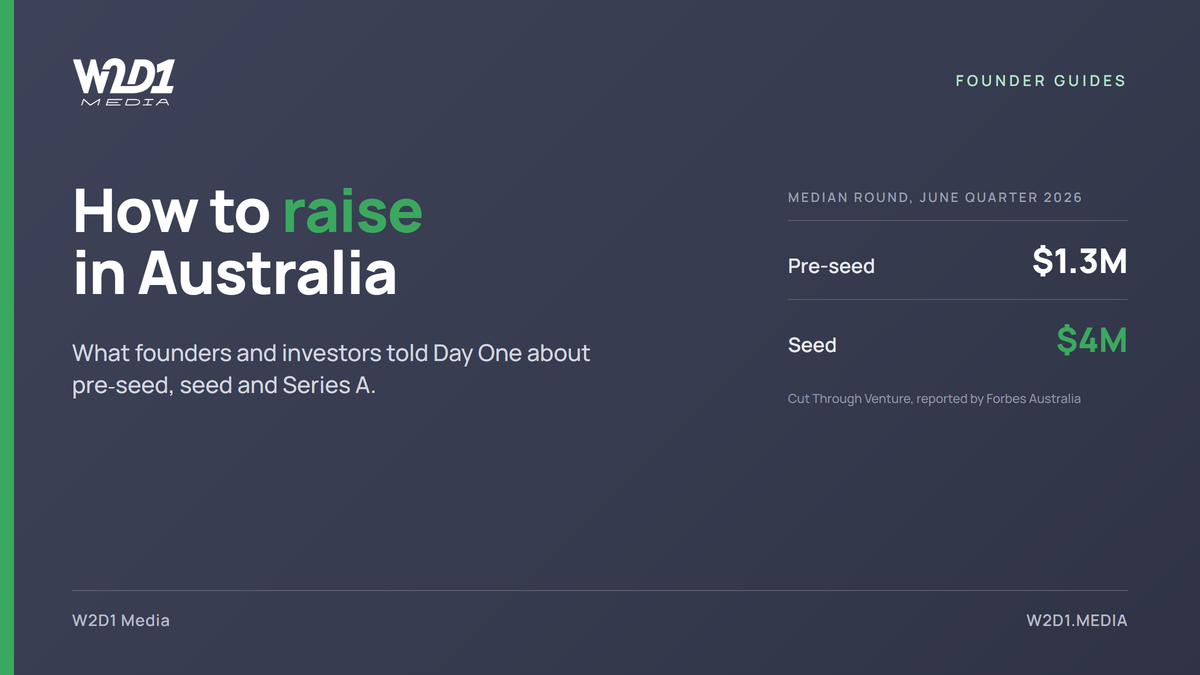
The headline numbers say money is flowing. Cut Through Venture counted a record A$4.2 billion raised by Australian startups in the September 2026 quarter, but $2.85 billion of it was a single raise by Firmus. Without it the quarter came to $1.31 billion, and the number of announced rounds fell to 92 from 123 a year earlier. The quarter before shows where the money went. In the three months to 30 June 2026, A$1.7 billion was raised, up 60 per cent on a year earlier, yet just 31 rounds were under $5 million, the lowest early-stage deal count since Cut Through began collecting data in 2020 and 44 per cent below the 2025 quarterly average. Median pre-seed and seed rounds that quarter were $1.3 million and $4 million, the highest on record. Money is flowing to fewer, larger companies.
The full-year picture for 2025 was similar. The annual report by Cut Through Venture and Folklore Ventures now puts 2025 at $5.4 billion, up 31 per cent on 2024, across 390 deals, 20 per cent fewer than the year before. As first reported in February, the 20 largest deals took 58 per cent of all capital and two thirds of deals included at least one international investor, and SmartCompany's summary said fundraising timelines "continued to stretch".
Investors on our shows describe the same squeeze from the inside. On First Cheque's 2026 outlook, Cheryl Mack said "total quantum of investment on later stage was up 300%, whereas pre-seed and seed were down like 50%", though she did not name the data behind that. Maxine Minter, who runs the pre-seed fund CoVentures, described "really, really excellent teams struggling to raise sufficient capital, not because they don't have a great idea or a great business, but because there's just like not enough capital moving around the ecosystem".
What that means in practice: fewer cheques at the early end, bigger cheques for the companies that get them, more competition for every meeting, and a real chance that a good company will not raise for reasons that have nothing to do with the company.
Should you raise at all?
Venture capital is a specific product. Paul Stovell, who grew Octopus Deploy on its own revenue for years before taking outside money, put it plainly: "you're not pitching, you're selling a financial product to these folks and you have to be so conscious of it". The investor is buying a chance at a very large outcome. Maxine Minter explained the maths from the investor's side: of early-stage venture investments, "about 50% of them will go to zero" and the next 10 to 20 per cent return roughly the money invested. Funds live on the few that return 100 times. A company that will be a good $30 million business is often a bad fit for that model, however well run.
Founders who have done both describe the choice as a fork, not a stepping stone. Supabase co-founder Paul Copplestone, who also invests as an angel: "Don't half-ass either of them. Just go all in on whatever route you want". Rachel Carrell of Koru Kids chose venture deliberately: "it was a conscious decision not to bootstrap".
Three tests come up again and again.
Can each dollar become ten? AutoGuru founder Eden Shirley: "Unless you can take that dollar and turn it into 10, don't raise because it comes with expectations, extra reporting, extra influence". She also says AutoGuru "totally underestimated how much you need to raise to build", so the test cuts both ways: if you do raise, raise enough for the plan.
Can you afford the alternative? Steve Scheding of Green Atlas framed bootstrapping as a personal question: "Could you leave your current job and have 12 months or 18 months where you're not earning any money?"
Would control or speed matter more to you? Alan Jones, the angel investor who hosts Pick My Brain, argues that bootstrapping keeps you "in control of how fast that happens and who's involved and the strategic direction of the business", and that a profitable, fast-growing company negotiates from a much stronger position if investors later come knocking. Against that, Emily Rich, a former founder who later invested, said of bootstrapping her own company: "I would never do that again because I could have grown it's so much bigger and so much quicker".
Raising also costs time. Jess Ruhfus told Unfunded she spent "50% of my time" trying to raise before she gave up and bootstrapped.
Money that does not cost equity
Before you sell shares, check what you can fund without them.
The R&D Tax Incentive. For a company with aggregated turnover under $20 million and the 25 per cent base rate, it pays a refundable offset of 43.5 per cent of eligible R&D spending: the company tax rate plus 18.5 percentage points. Dr Prashanth Rajan of Brandon Capital described it in July 2026 as providing "a 43.5% rebate". A change is coming. From 1 July 2028 the cash refund is to be limited to a company's first 10 years of operation (15 years for therapeutic goods R&D in the draft law), with a non-refundable offset after that. The Government announced it in the 2026-27 Budget and consulted on draft legislation in September 2026, but it is not yet law. Investor Tom Humphrey called the incentive "a little secret weapon" on First Cheque: a team built and paid in Australian dollars, with 43 cents back on the dollar, selling into the US in US dollars. Check eligibility with an adviser.
Grants. They help, but they are slow and competitive. Phil Ireland of Hone Carbon has seen "thousands of applications for a couple of grants, in which case your likelihood of success is close to zero" (2022). Darryl Lyons of Eskavox won a $1 million Accelerating Commercialisation grant and warned that the program paused around election caretaker periods (2022). That program closed to new applications in May 2023, and its successor, the Industry Growth Program, has been paused to new applicants since 12 May 2026. Programs change often; check business.gov.au for what is open now.
Customers. Aaron Cowper of Shoprock gave a large early customer about a 10 per cent discount to pay a year upfront, because "my cost of capital was so high that it made sense". Kathryn Zealand of Skip takes $100 pre-order deposits, not for the cash but because they help win "working capital financing or venture debt".
Revenue-based finance. Lenders such as Tractor Ventures advance money that is repaid as a share of revenue over a couple of years, without taking equity. This description comes from the lender, in 2022; compare current terms.
Pre-seed
What it is. "Pre-seed is a risk stage. It's not a monetary stage," says Maxine Minter. You are raising to prove there is a business, not to scale one. Rounds in her fund's portfolio ran from $500,000 to $1.5 million, most between $750,000 and $1 million, at an average valuation of about A$8 million across 2023 to 2025. That is one fund's portfolio, not a market average; the market median for pre-seed rounds in the June 2026 quarter was $1.3 million.
The first round is often the hardest. Liam Millward raised $2.5 million from Blackbird for Instant, a round In the Blink of AI introduced as the largest pre-seed in Australian history. The round before it, $200,000 from two Singaporean angels that let him go full-time and hire an engineer, gets less attention: "we never spoke about the $200K round. That was the hardest round I've ever raised". When it works, a pre-seed can move quickly. Dr Ariella Heffernan-Marks of Ovum "started raising in October and we were closed by December. Um, we oversubscribed".
What pre-seed investors are judging. Mostly you. Maxine Minter tells founders the product they pitch is "very unlikely to be same product, very unlikely to be same customer, very unlikely to be same go-to-market" by product-market fit, so "I'm trying to understand how you think and how you move". Ilana Elbaz, an operator angel who leads go-to-market at Deel, asks "which customer you talk, when did you talk to them, what they ask you" and how fast you iterated. Freddie McKenzie of Manifest says his pre-seed came through in a hard market because of "a deep level of domain expertise" and access to customers.
Who writes pre-seed cheques. Angels, angel syndicates, accelerators and a small number of pre-seed funds. In 2022 Cheryl Mack, who runs the Aussie Angels platform, described the gap between a friends-and-family round of about $100,000 and a $500,000 to $1 million pre-seed, with "very few true pre-seed funds"; there are more now, but founders still describe the gap. Accelerators are one route. Startmate invests $120,000 for 8 per cent at a $1.5 million valuation; its Winter 2024 cohort, announced in August 2024, was 11 companies chosen from about 600 applications. Airtree's Frontier residency puts $250,000 into founders on an uncapped SAFE, even before they have an idea. Airtree's Cloë Stanbridge said on Building Tech Teams that it drew 400 to 500 applications; Airtree has not published a figure.
Set expectations for small cheques. Angel Tim Rossanis, who writes cheques of up to about $10,000: "We're not like making or breaking their round". Precursor's Charles Hudson describes the same thing from a fund: some founders expect nothing from a $100,000 cheque in a $5 million round; others expect a lot because "You're half of my pre-seed round". Know which investors on your list can lead and which will follow.
SAFEs, notes and priced rounds
Most Australian pre-seed money now comes in on a SAFE, a simple agreement that converts into shares at your next priced round. Adam Ingles, a fractional CFO, uses SAFEs for pre-revenue companies because they avoid "spending weeks going back and forth between investors and founders on valuations", and moves to a priced round once revenue arrives.
Why not a priced round from the start? Cost and coordination. Maxine Minter puts legals for a priced round at between $20,000 and $60,000: "If you're raising $500K and you're spending more than 10% of the capital that you've raised on the lawyers, like there's something wrong there". Investors disagree on the number (on another episode she said $50,000 to $80,000 and Cheryl Mack said about $30,000), which is itself the lesson: get quotes. A priced round also has to "close it all at once", which makes it a single point of failure: one key investor pulling out can collapse the close.
Know what you are signing.
- *The cap.* Maxine Minter's worked example: with a $5 million post-money cap, SAFE investors convert as if they bought at a $5 million valuation, even if the next round is priced higher. If the next round is a down round, "you no longer have the benefit of the cap".
- *Discount and discount rate.* They are not the same. Cheryl Mack has seen terms written as "discount at 80% when it should have said discount rate".
- *Post-money versus pre-money.* "The post-money is more investor-friendly," says Cheryl Mack. It gives investors more certainty about their stake and "there is more dilution for the founder".
- *Expiry dates.* Some SAFEs force conversion after 24 to 36 months. Maxine Minter calls them "predatory"; Cheryl Mack has seen them several times and is less worried.
- *Pro rata.* The right to invest in later rounds is not in the standard Australian SAFE template Cheryl Mack refers to, and often turns up in a side letter instead.
The Australian wrinkle: ESIC. Early Stage Innovation Company status gives eligible investors a non-refundable tax offset of 20 per cent of the amount invested, capped at $200,000 a year, and modified capital gains treatment for shares held between 12 months and 10 years. Investors who are not sophisticated investors can put in no more than $50,000 a year to qualify. The company is tested when the investor is issued shares; for a convertible note, the ATO says the date of conversion is what counts. Cheryl Mack, speaking on First Cheque in 2024, applied the same to SAFEs: an angel who invests on a SAFE cannot claim until it converts. A company that qualified when the SAFE was signed can fail by the time it converts, because the test looks at the previous income year: assessable income of $200,000 or less and total expenses of $1 million or less, plus an age limit (the ATO explains the tests). A conversion after 1 July is tested against the year that has just ended. Some investors now ask for an option to convert before a new financial year if you are likely to stop qualifying. Tell angels where you stand on ESIC even if you are raising on a SAFE, and check the current ATO rules.
ESVCLP funds have rules that may affect you. Many Australian funds invest through Early Stage Venture Capital Limited Partnerships (ESVCLPs). Their tax benefits depend on the investee being an Australian resident with more than half its employees and assets in Australia, although a fund may put up to 20 per cent of its committed capital into companies that fail that test. Sam Wong of Blackbird Ventures said on First Cheque that Australian founders who move their company to the US or UK land "in the foreign bucket". That is not always so. The rules treat a holding company resident in the US, UK, Canada, France, Germany or Japan as eligible if it wholly owns an Australian-resident operating company that meets the tests, and each fund also sets its own limits. If you are thinking about a US parent company, ask your Australian investors how it affects them before you flip.
Say what you are raising on. Alan Jones's checklist for a pitch: is it a SAFE, a convertible note or a priced round, how much, and "if it's a SAFE note, how high is the cap? If it's a convertible note or priced equity round, you know, what's the pre-money valuation?" Angels mostly take the terms as offered. Cheryl Mack's description of how pre-seed terms reach her: "here's my $4 or $5 mil SAFE with a 20% discount, take it or leave it".
Finding investors
Warm introductions win. When The Startup Retro reviewed one startup's published fundraising log, "by far the biggest category of how they ended up speaking to an investor was warm intros". Cheryl Mack says the research matches her experience: through a warm lead, investors "will look at it and spend more time with it", even outside their thesis. Alan Jones: "Australia is a relatively friendly place. People will allow you to buy them a coffee. Especially look if it's come through a warm introduction".
Ask for advice before you ask for money. Dan Draper got his first Airtree meeting by asking for a coffee: "I wasn't looking for money at that stage. I was just looking for advice". Investors already on your cap table are the best source of the next introduction; Airtree later introduced CipherStash to Nexus Venture Partners in Palo Alto, which invested.
Do the outreach. "Don't wait for them to come to you," says Maxine Minter. Founders "should outbound the people who are most strategic for your cap table accordingly". Size the list for the odds. Yotam Rosenbaum, a YC alumnus and investor: "If you want to close 3 investors, you'll probably have to reach out to at least 30". From the other side, Rachael Neumann of Flying Fox Ventures said in 2022 that to write about 10 solid cheques a year an investor should look at about 1,000 companies.
Research investors like customers. "Every investor, first of all, has her or his own investment thesis," said Rachael Neumann. Read their website and portfolio, then "think about them like a customer, like a customer discovery". Fit on thesis, stage, cheque size and location decides many answers before your pitch does.
Expect to be researched. Sally, an investment principal at King River, told an In the Blink of AI panel she receives more than 1,000 cold emails a year and uses an AI agent to research each sender's LinkedIn, website, recent posts and GitHub. Your public footprint is part of the first read.
Who goes first matters. Angels follow people they trust. Angel investor Rayn Ong described a respected domain expert who "not only invested in the company, but he also joined the team. So that was a pretty strong signal for me". Plan which name you want on the cap table first.
The deck
A deck opens a door. Its first job, in Alan Jones's words, is "to get to a conversation". He uses three versions:
- a teaser of three to five slides, "something which creates more questions than it answers", built around "your 3 strongest, most interesting things";
- a pitch deck of "10, 10-ish, 12-ish, 15-ish at the most", to support a meeting;
- a leave-behind deck with "however much information you have".
Australian investors differ on what they want first. Justin Wastnage of Vloggi told Pick My Brain that most Australian investors "just want to see a PDF of the pitch deck" and decide from that; Alan Jones prefers a teaser upfront and suggests asking each investor what they want to see. He also suggests testing the long deck on three to five representative leads, not your best ones, before sending it widely. And write it to be read cold: "we are starting to see a lot of investors say, sure, send everything you have because I'm just going to use an AI to ingest it all and give me a summary and give it a score out of 100".
What goes in. Adam Ingles's three essentials: traction, what the money will be spent on, and the team. Make the ask concrete. Alan Jones coached one founder to replace a bare request for $1 million with "very measurable, accountable goals" for the money, so "it feels more like a commercial exchange of value". Show something real if you can. Rohan Workman of Skalata: "we won't invest on a on a deck" without evidence the founders can build, "even if it's a really initial basic one, an MVP. or a prototype or a some sort of commercial kind of pilot". Serial founder Frank Greeff would rather pitch "with a prototype that you're clicking" than with a deck.
In the room, the deck supports you. "Think about your pitch deck as supporting you telling the story, not taking the place of you telling the story," says Alan Jones.
Do not outsource it. Jodie Imam paid an agency to produce "literally 100-page document that was like a pitch deck but an IM combined" and an introduction to its investor network, which "didn't really introduce us to too many investors that were actually ready to invest".
Some companies raise without a deck at all. Paul Stovell never made one, because Octopus was profitable and investors came to him. That is leverage, not a template.
What investors look for, by stage
Pre-seed and early seed: the founder and the problem. "At kind of the pre-seed inception seed stage, it still really is like all the founder," says Taryn Pieterse of Rampersand. "By kind of late seed, early Series A, you kind of want some proof". Elizabeth Yin of Hustle Fund looks for "founder-market fit. Like, do they know a lot about this thing" and "their nuanced insight into this problem". Amy Saper of Uncork Capital invests "in slope, not y-intercept": not where you start, but how fast you learn, which she checks in conversation and with your references. Cheryl Mack asks how painful the problem is: "acutely painful, felt" and frequent enough "that they're willing to pay to solve".
Small things investors notice. Alan Jones of M8 Ventures watches whether founders act on advice: "I want to see that advice, evidence that advice might actually be acted on between now and the next time we speak". He prefers teams to solo founders, and when he backs a solo founder "often it's in the hope that I might be able to influence or assist with the building of a team". Maxine Minter warns investors against confusing "credibility, right, the capability of actually doing the thing, with being eloquent and talking with a high degree of energy": expect probing questions behind a polished pitch.
Capital efficiency. Rohan Workman wants companies to "reach the next milestone with our initial check", and describes Skalata's current first cheques as up to $500,000, mostly a few hundred thousand, at valuations up to about $10 million.
Ambition, told to the audience. Georgie Turner of Tidal Ventures described US investors as expecting "the outsized outcome" and Australian investors as "generally looking for the downside protection" and more open to "that mid-sized market exit story", and advised founders to "temper that conversation depending on who you're speaking to".
Decoding "not a fit". Maxine Minter translated the phrase on First Cheque: most likely the company "isn't a thesis fit for the fund", sometimes a stage mismatch, and from angels, "too far along" can mean they assume your valuation is too high.
Running the raise
Start the relationships months before you need the money. Fiona Brownfoot of Kali Healthcare: "I think everybody that then invested, we had been in discussions with for over 6 months". Aonghus Stevens of Asseti spoke with Tidal Ventures "for, you know, 9 or 10 months" before a term sheet, and his advice is blunt: "don't go to market when you need the money". Alan Jones suggests a running record of progress for prospective investors: "start early enough that you can start showing them and updating them on a regular basis".
Budget the time. Eden Shirley: founders "might start with a 12-month runway, but if it takes 6 to 9 months, that runway is quite short by the time you have success". Allen Fan of CarbonHQ spent six months of a pre-seed raise talking "to every single investor in Australia and Singapore and New Zealand", which "really takes the focus away from building the product". In 2019 Alan Jones put an Australian seed at "a 6-month to 18-month journey". If you can, raise in a burst. Yotam Rosenbaum: "there'll be a huge difference if you squeeze that into a 2-week period versus a 6-month period". Set a deadline only if it is real and the meetings are booked: "you're saying, yeah, I'm raising, I'm starting today and I'm closing in 6 weeks. And you have only 3 calls on you scheduled for those 6 weeks, you're most likely not going to raise the capital".
Mind the calendar. Alan Jones: raising toward the end of the Australian calendar year "is always going to be tough" because investors do not want to "write large checks just before I take the family away for, for a Christmas holiday".
Run it like a sales pipeline. Campbell Brown of PredictHQ has kept "a CRM for investors for 5 years": "just run it like a sales process" and remember that "a fast no is better than a slow maybe".
Momentum is everything, and the first yes is the hardest. "No one wants to be the first one. To say yes, but nobody also wants to lose on a good deal," says Yotam Rosenbaum. Once a known investor commits, use it: "you can say to an investor who hasn't committed yet, you can say ... so-and-so are already in". Yas Grigaliunas set out to raise $3 million in three weeks, had almost $1 million committed when a strategic investor offered the whole amount, declined so it would not be the only name on the cap table, and "raised $4 million in 4 weeks".
Keep another path open. Green Atlas ran a seed process "to never assume that the raise would be successful", lining up a grant, its own money and a customer pilot, and reached due diligence with two firms that both pulled out "for two different reasons, neither of which on face value were us". A term sheet is not money. Eden Shirley had one "ready to close" in April 2020 when lockdowns hit and the international investor paused. Cameron Adams recalls a Canva round in which the lead investor pulled out and the founders "had to scramble to find a new funder to come in, to totally rewrite the term sheet".
Prepare for diligence. Investor Dan Gavel describes it as trying to talk himself out of a deal he already likes. Have a customer reference list ready: Alan Jones's M8 Ventures asks for "a customer list and their contact details" to run interviews. Judy Anderson-Firth of the family office Euphemia listed what she checks: constitution, shareholders' and subscription agreements, the cap table and corporate structure, IP assignments ("does the company own all the things that it needs to own?") and employment agreements. Understand your own documents: Rohan Workman sees deals slowed or stopped because "founders haven't gone through the experience of really understanding what a subscription agreement entails or a safe". And remember who is on your side of the table. "It's my job to get a good deal," said investor Kylie Frazer. Get a lawyer who works for you.
Read the negotiation. Maxine Minter says "the important terms for investors are in your term sheet", so "let the lawyers sort it out" about a term that is not there usually means they do not care about it. Cheryl Mack adds that fights between lawyers "just racks up fees".
Valuation and dilution
How investors think about price. Pre-seed funds work back from the exit. Maxine Minter: "we're looking at 100x return profiles", allowing for "about 50% of your position to be diluted down" between pre-seed and a Series C to IPO exit. Capital-hungry businesses (hardware, deep tech, climate, AI infrastructure) should expect more dilution and model it. Australia also prices "almost a whole round earlier" than the US: she gives average US seed rounds of about US$15 million and Series A rounds of US$48 million, while Cheryl Mack sees Australian seed valuations of about A$8 to 12 million. Maxine Minter puts the typical step from an Australian pre-seed to an Australian Series A at about 4x.
Investors disagree on how much price matters. Cheryl Mack says "there is actually never a valuation that is too high"; her test is whether the company can double its valuation at the next round. Elizabeth Yin says valuation "does matter": for most companies it is "a difference between potentially getting 20x multiple versus 100x multiple".
A high price can cost you later. Craig Blair warned on First Cheque that a company taking money "at too high valuation" will find it harder to do what the Series A requires: "they're going to have a problem in 18 months' time". Melissa Widner, speaking in 2022: "Pick your investors, not your valuation".
Justify the number. Alan Jones's method: state this round's valuation and the Series A valuation you will need about 2.5 years later, then the customers each requires: "to justify a $5 mil valuation, we need this many customers. To justify the $20 mil valuation in the Series A, we're gonna need this many customers". Get finance help before you set the price. Adam Ingles recommends a part-time CFO "as soon as you are starting to think about either fundraising", because it "can really make a big difference between a good deal and a bad deal".
Plan the option pool. Alexey Mitko, who advises on employee equity, sees companies give away too much early: plan for "the number of rounds that your company has to go through, the number of people you'll have to hire, retain" before granting equity.
Read the side letters. Maxine Minter saw "ratchet clauses or liquidity preferences" appear in side letters at seed and later in 2023 and 2024, which "can be a disaster for founders and sometimes means that founders and the ESOP walk away with nothing". Lauren Hall of Ivy: "Having really, really highly skilled corporate lawyers right from the beginning is fundamental".
When the answer is no
Expect a lot of them. Slice co-founder Farouk Ismail approached 35 to 40 Australian investors for a round, "all of them actually, just rejected us pretty much, or, you know, it was like a long no kind of thing". By Farouk Ismail's account the company took six years to raise its first external round, a A$7.5 million seed led in 2024 by Peak XV, the Asia-based fund formerly known as Sequoia Capital India and Southeast Asia. Frank Greeff had five firms say no, among them Airtree, Square Peg and Blackbird. Startmate rejected Liam Millward, with feedback that included "too young" and "big competitors", before Blackbird backed him.
Decode "too early". Cheryl Mack estimated on First Cheque that "like 90% of the time it's actually just another word way of saying no", with a "5 to 10%" chance it is genuine. Ask why. Charles Hudson of Precursor Ventures tells founders directly when he passes and why; some later close the round without him, and others come back to say everybody else told them "the same thing you told me about their reservation". One founder rejected by an accelerator "followed up with the mentors who interviewed us", asked how to fix each point, and learned from all of them.
If you have pitched the same investors for years, change the story. Alan Jones suggested creating "a bit of an air gap between what investors think that they know" about a company and what it is now, for example with a new product brand or a different person leading the pitch.
If the round will not close, act early. Alex Feldman, an M&A adviser, says "raising and selling is almost the same activity. You are selling shares", and when no one will invest, "never waste a crisis": cut costs hard and "buy runway". Do not wait until you are desperate. Sheree Rubinstein: "so often I see people doing it from the place of desperation ... you're never going to get a good deal".
From seed to Series A
The odds. Series A is where many companies stall. Maxine Minter cited US data in late 2024 showing about 20 per cent of seed companies reached a Series A within 36 months, against a historical 30 to 40 per cent. Treat these as US benchmarks; Australian data is thin.
The bar. There is no fixed number. In 2024 Maxine Minter said Australian investors tell companies they want "somewhere between $2 and $5 mil ARR, AUD" before a Series A; Cheryl Mack heard $2 million most often, with a real range of "$200K and $5 mil" because deep tech, medtech and climate tech do not fit the pattern. Investors on First Cheque say the number is the wrong target. Maxine Minter: what investors want is risk removed. "You have a product, the market wants it, That you can repeatedly sell it to them, that you can scale that repeatability, that, that revenue has durability". Brennan O'Donnell of Frontline Ventures: start with product-market fit and repeatable sales "before you can ever kind of think about getting to the revenue target". Maxine Minter describes the stages by the risk each funds: seed funds early signs of product-market fit, Series A funds "the company building around verified product market fit", Series B your ability to build a big company.
Quality of revenue matters more than it did. Elizabeth Yin: five years ago $10 million of SaaS revenue meant "you're pretty golden", but now some companies "lose all their revenue overnight because competition is so fierce". Before a process, check your own numbers. Paul Stovell had an adviser audit Octopus's ARR before raising because "ARR isn't actually like a very well-defined metric".
Do not scale what does not work. Darius Monsef raised more than $40 million for Brave Care: "We scaled a model that wasn't working yet. ... I then now have a business that's losing $1 million a month".
Growth rate sets your options. Zak Holdsworth's company grew 30 to 40 per cent a year with strong retention, which was not the "double, triple" venture investors wanted. He turned to private equity, which he says starts looking at roughly $7 to 10 million ARR and accepts "a 3 to 5x return" instead of 100x.
Expect to look offshore, and decide how far to go. In 2022 Georgie Turner of Tidal Ventures said a B2B business generally needs to sell globally to get past about $5 million of revenue and to attract capital after Series A. US investors are asking more of Australian companies than they did in 2021. Cheryl Mack: US co-investors are "asking for or Delaware C-Corp, substantial presence in the US, or, and/or that the founders have an intention to kind of relocate to the US". Investors split on relocation. Marvin Liao said in 2024 he will not invest in founders unwilling to move to the US; Cheryl Mack answered with Canva, Atlassian and Airwallex, built from Australia. Elizabeth Yin of Hustle Fund is "okay going into opportunities that will stay local". Matthew Browne's middle path for entering the US: six months in residence, then "8 to 10 trips a year".
US money can move faster. Annie Liao of Build Club said two of its accelerator companies with US lead investors got "a better valuation and faster decision to yes", though "I don't think you're like set back also if you just choose Australian VCs". Relevance AI chose an Australian lead for its Series A for the personal relationship and valued US investors for industry insight "at pretty much the largest scale possible".
Price the first round with the US seed in mind. Maxine Minter: for US investors, "it is a red flag for them if the founder has sold too much of their company at too low of a valuation", for example a US$3 million post-money pre-seed followed by a search for a US$25 to 30 million seed.
On flipping to a US parent company, our archive is thin. No guest has walked through the mechanics, cost or timeline. Dan Draper said CipherStash had "flipped up to the US" and that the filings drew investor attention. New Zealand founder Campbell Brown kept a New Zealand parent for tax reasons, said his board at times wanted to flip, and concluded that "if someone's saying, no, you have to be this, then they're probably not worth taking money from"; his tax points are New Zealand-specific. Talk to an Australian and a US startup lawyer and accountant before you decide, and to your ESVCLP investors (see above).
After the raise
Send updates before anyone asks. Maxine Minter says even a light monthly update is "really valuable"; an investor asking for one is a sign you are under-communicating, and when investors start asking about cash and burn, "they are either really excited about how you're doing or nervous. Mostly they're nervous". Information rights in your documents are a narrower, legal thing. The First Cheque hosts disagree on writing updates into the contract: Cheryl Mack would like them "contractually obligated", while Maxine Minter would not encourage founders to agree to it. Put asks in them. Angel Tim Rossanis says founders with many angels leave "latent potential" unused unless they send "structured updates, uh, where you're requesting help". Alan Jones adds a rhythm of one-to-one calls: two or three investors a week, "I'm not going to take more than 10 minutes of your time".
Do not assume follow-on. "If Sequoia leads it, I'll do my pro rata" is, in Charles Hudson's words, "not a yes". Ask existing investors directly whether they will invest in your next round. Pro rata rights are also negotiable at the next round: Cheryl Mack describes angels being asked to waive them when a larger investor needs room, and Maxine Minter describes founders negotiating earlier investors out of their follow-on at a competitive Series A.
Build the board on purpose. Taryn Williams, who built and exited six companies, says her boards were assembled on "I know a guy who would be good", not a skills matrix, and she would now be "much more mindful about how I build a board and good governance". What changes in practice can be modest: Octopus's board meetings went from a monthly founders' call to two-hour quarterly meetings when Insight Partners invested. Charles Hudson: "likability wins on the front end and trustability wins in the long term".
If things go wrong. Down rounds can bring recapitalisations, in which, Pocket Sun of SoGal Ventures explains, a company "might kick out some old investors who are no longer active". Eden Shirley's investors bridged AutoGuru through the pandemic with convertible loans that were later repaid.
Get the checklist
We have turned the practical steps in this guide into a two-page checklist: what to decide before you raise, what goes in your deck and data room, how to run the process and what to send investors afterwards. Get the raise checklist.
How this guide was made
We transcribed and searched hundreds of episodes across the Day One network, which W2D1 Media produces, for fundraising discussion, read the strongest passages in context, and kept only quotes from people describing their own experience or their own investing. Speaker labels in some transcripts are machine-generated and were checked against the conversation; quotes have been lightly trimmed but not reworded. The market figures come from reports by Cut Through Venture (and, for the annual report, Folklore Ventures), from Cut Through's own pages and as reported by Forbes Australia, SmartCompany and Startup Daily. Tax and program details were checked against the ATO, Treasury, business.gov.au and the programs' own pages on 16 October 2026.