

A column
The Content Machine
Startups and scaleups that run content as a system, with the evidence that it moves the business. One company per instalment: what it makes, how often, how it reuses it, where it goes, who makes it, how it is measured, and what it does for the business. Every figure attributed, the company's own numbers labelled as such.

No. 19 · 16 Oct 2026
How Wistia bought out its investors, decided it was cheaper to make shows than to advertise on them, and built a studio inside a software company
In 2017 Wistia borrowed US$17.3 million to buy out its own investors and stop chasing an exit. Two years later its founders wrote down a method they called Brand Affinity…
No. 18 · 15 Oct 2026
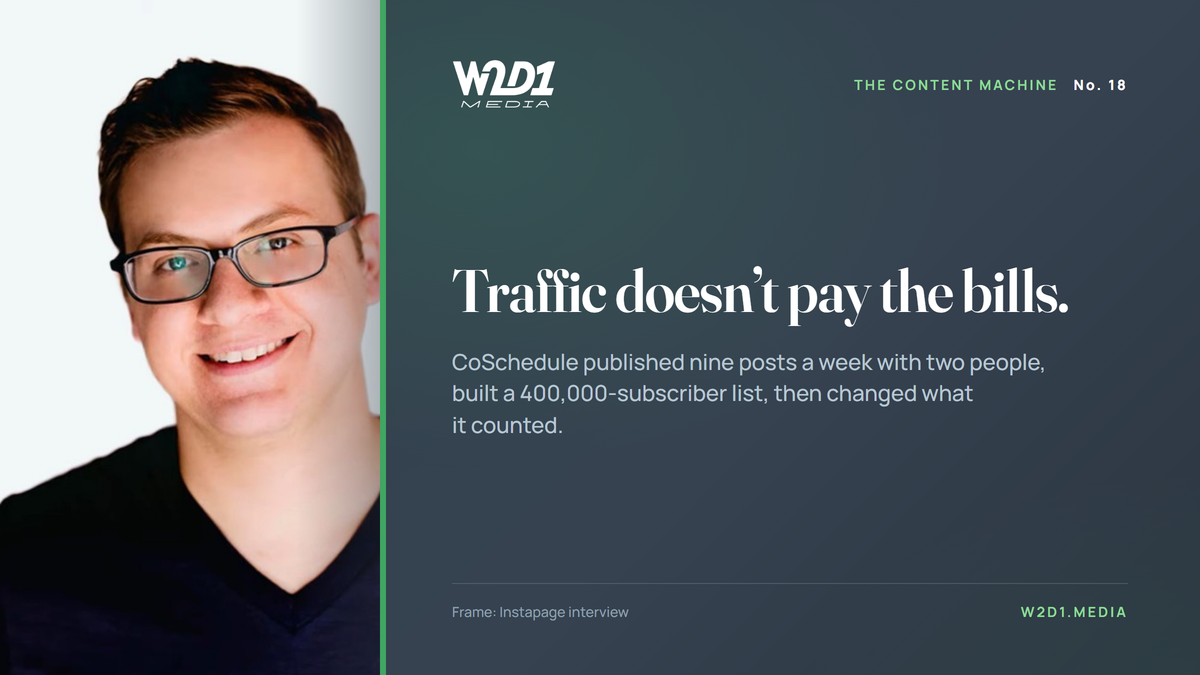
How CoSchedule published nine posts a week with a team of two, built a 400,000-subscriber list on it, and then learned that traffic doesn't pay the bills
CoSchedule sells a marketing calendar from Bismarck, North Dakota, and for most of a decade it ran the most prolific blog in its category: eight or nine posts a week with two…
No. 17 · 15 Oct 2026
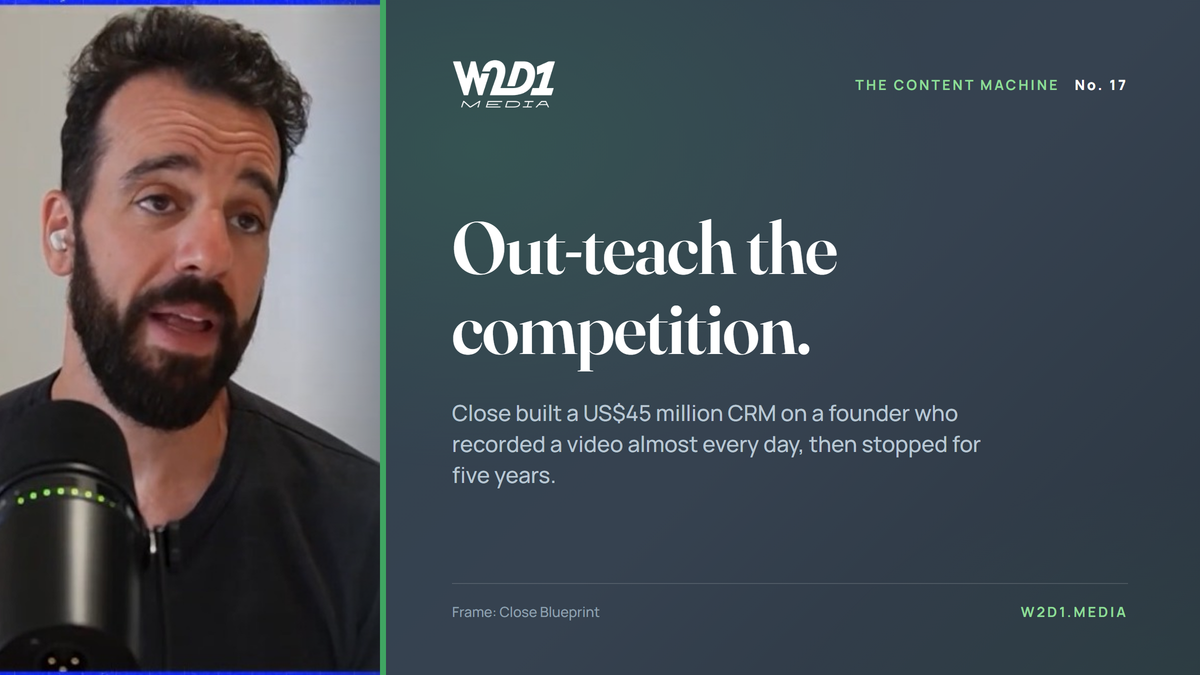
How Close built a US$45 million CRM business on a founder who recorded a video almost every day, and then went five years without doing it
Close launched in January 2013 with six people, no search advertising, no search optimisation and no outbound sales. Its founder decided to out-teach the competition instead: a…
No. 16 · 15 Oct 2026
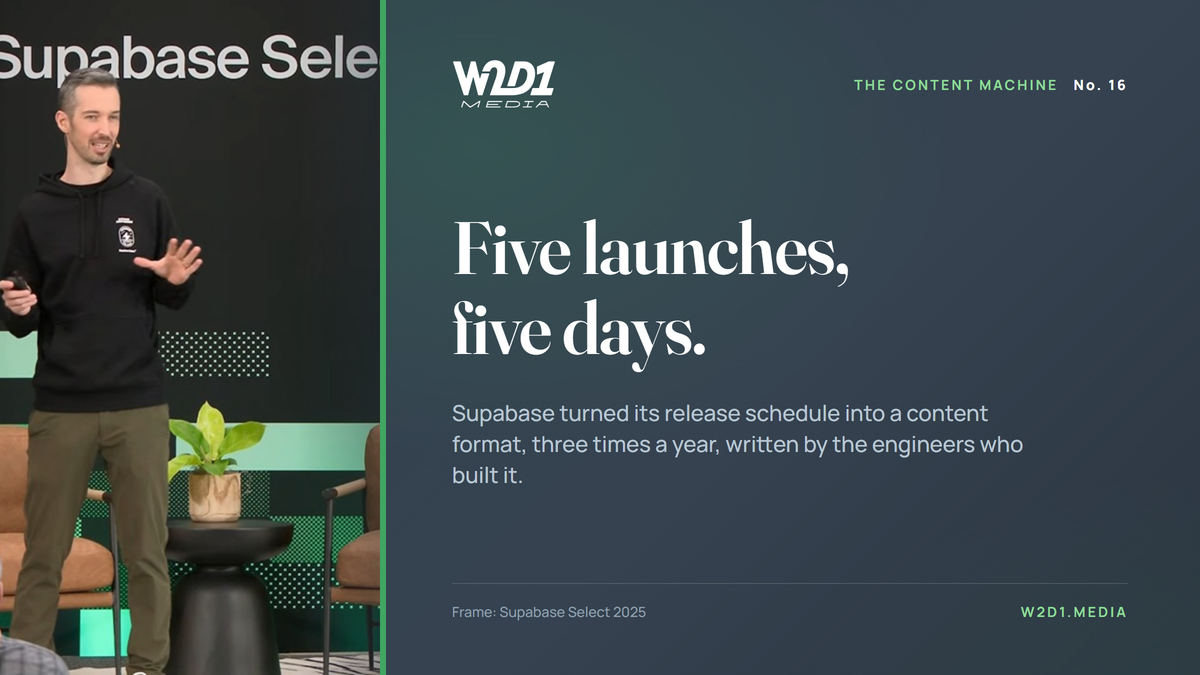
How Supabase turned product launches into a content format, ran it three times a year, and grew the databases it hosts 47 percent a month while doing it
Supabase ships one feature a day for five days, three times a year, and calls it Launch Week. The engineers who build each feature write its post. The company says that rhythm was…
No. 15 · 15 Oct 2026
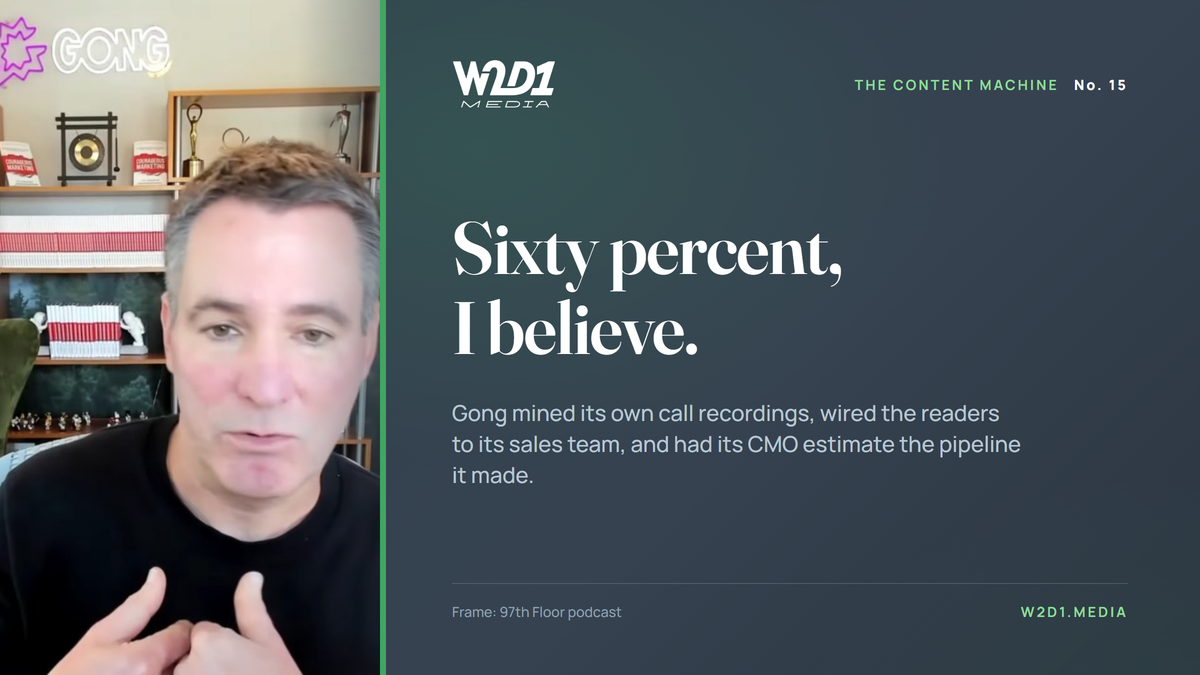
How Gong turned its own call recordings into a research series, wired the readers to its sales team, and had its marketing chief put it at 60 percent of pipeline
Gong records sales calls for a living, so its content team mined the recordings and published what the best salespeople do differently. One ungated article got thousands of shares…
No. 14 · 15 Oct 2026
How Ahrefs built a US$100 million self-serve business on a blog, a YouTube channel and free tools, and why its marketing chief refuses to count what the content returns
Ahrefs sells SEO software, and it markets it by teaching SEO in public: more than a thousand blog posts, a YouTube channel publishing about twice a week, free courses, a podcast,…
No. 13 · 15 Oct 2026
How Userpilot went from four articles a month to more than a hundred, tripled its organic traffic, and then rebuilt the whole thing when search stopped sending the right companies
Userpilot's marketing lead was the only marketer at the company. Search brought 70 percent of sign-ups, so in 2021 she stopped everything else and built a content factory: a head…
No. 12 · 15 Oct 2026
How Tailwind Labs built a multi-million dollar business on free documentation, and what happened when the documentation stopped bringing people in
Tailwind Labs never ran a marketing department. Its founder taught a CSS framework in public, sold a book and a component library to the people who learned it, and said in 2020…
No. 11 · 15 Oct 2026
How Unbounce traced one research report to 206 trials and US$13,293 a month, and why the person who counted it had to publish it herself
In 2020 Unbounce's content team shipped a Conversion Benchmark Report, launched it on Product Hunt, and then did the thing almost nobody does: followed the downloads through to…
No. 10 · 15 Oct 2026
How Sprout Social turns one research report a year into a lead machine, and told its shareholders content brings in most of its new customers
Sprout Social sells social media software and markets it with the thing it sells. Its annual Index, a research report built from its own data, launches with a named team of…
No. 9 · 15 Oct 2026
How Culture Amp built a community of people geeks before it built a marketing department, and what the founder says it did for the funnel
Culture Amp's content machine is a community. A weekly newsletter for HR people, a conference called Culture First, and in one year 120 events across 23 cities, run by a company…
No. 8 · 15 Oct 2026
How Buffer built a company on a blog, let the machine lapse, and restarted it: the only content story here with a middle
Buffer's co-founder wrote roughly 150 guest posts in under a year and credited them with the first 100,000 users. Its blog then shipped four posts a week, counted every trial, and…
No. 7 · 15 Oct 2026
How PostHog runs content with no volume targets, no freelancers and no AI, and publishes the rules so you can check
PostHog's content operation is written down in public. No arbitrary volume goals, no freelancers, nothing written by AI, shares as the measure, and a newsletter that went from…
No. 6 · 15 Oct 2026
How Apollo.io made its customers, partners and staff the content machine, and the one number nobody at Apollo has confirmed
Apollo.io's go-to-market machine runs on people. Three teams, one each for customers, partners and employees, get those people posting, speaking and hosting, with the company's…
No. 5 · 15 Oct 2026
How Hotjar went from "content is our worst channel" to a library of a thousand pieces, and what it says happened to paying customers
Hotjar's founder has said content was the last channel the company got right, because a single post took him a month. Then it built an organic search operation of more than a…
No. 4 · 15 Oct 2026
How Duolingo runs an owl, and what its own filings say the owl does
Duolingo's social team makes a cartoon owl threaten people, kills it off in a Cybertruck accident, and turns around a campaign in a week. That is the part everyone has seen. The…
No. 3 · 15 Oct 2026
How Intercom turned a founder's blog into the company's brand, and what the record does and does not prove
For most of a decade Intercom's marketing was a blog that shipped every Wednesday, a podcast every Thursday, and a shelf of books printed from the posts and handed out by the…
No. 2 · 15 Oct 2026
How Cognism stopped counting downloads, and what happened to the deals
In 2021 Cognism's marketing team generated 31,562 content leads and closed 46 deals from them, a rate the company itself puts at 0.14 percent. It then pulled the gates off its…
No. 1 · 15 Oct 2026
How Clay gets more than half its pipeline from marketing, and sells the content to its own sales team first
Clay's users make most of the content. Its executives post to a plan. A growth team runs a livestream series that has to pay for itself, hands sellers a list every Monday, and…