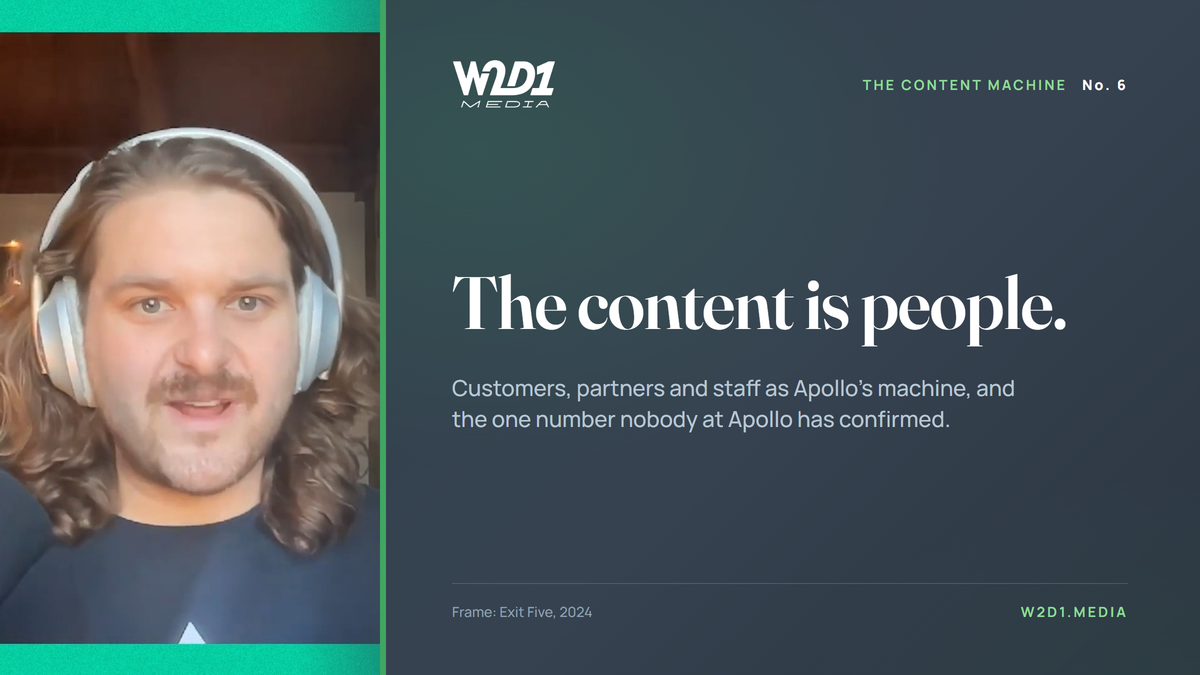
Apollo.io's go-to-market machine runs on people. Three teams, one each for customers, partners and employees, get those people posting, speaking and hosting, with the company's LinkedIn page as the amplifier. Its former head of community says about 76 percent of acquisition came through the programmes he ran. Apollo itself has never put a number on it. Here is the machine, what its builders say it did, and why the figure needs the caveat.
The Content Machine is a column about startups and scaleups that run content as a system: what they make, how often, how it is reused, where it goes, who makes it, how it is measured and what it moves for the business. Apollo.io is here because its machine is unlike the first five. The content is people, mostly other people, and the company's job is to organise them. A disclosure before anything else: W2D1 is an Apollo customer, for the outbound tooling, and I have no other relationship with the company.
The premise
Apollo sells sales intelligence: a database of contacts and companies, with sequencing and enrichment on top, free to start and paid monthly rather than on multi-year contracts, per TechCrunch's coverage of its funding. It was founded in 2015 by Tim Zheng and Ray Li, per Sequoia's investment note. In August 2023 it raised a US$100 million Series D at a US$1.6 billion valuation led by Bain Capital Ventures, and SiliconANGLE reported 40,000 paying customers, about 450 staff and revenue up ninefold in two years. In April 2025 the company said annual recurring revenue had passed US$100 million.
The machine, in one paragraph. A community team organised in three buckets: customer evangelism (an advisory board, affiliates, customers posting about their own results), community partners (influencers, integration partners, other people's communities) and employee evangelism (staff posting as themselves). Around them sit a free Slack community, eight or more free invite-only events a month, executive dinners, a free course library called Apollo Academy, and physical gifts sent to prompt posts. The company's LinkedIn page is the distribution point for all of it. The one piece to look at is an Apollo Academy masterclass, free, fronted by an outside expert, which is the pattern in miniature.
How it started
Before the community machine, Apollo grew the way product-led data companies grow: a free tier, a large library of pages built from its own database so that searches for a company or a person land on Apollo, and an academy of courses and webinars. The size of that search presence is disputed by the third-party tools that estimate it, so I am not quoting a figure. What matters is that by the time the community programme started, Apollo already had tens of thousands of paying customers and was growing fast.
The programme has a date and a name. Daniel Cmejla joined as vice president of community in February 2023, per a Reachdesk case study, after a similar role at Chili Piper. His account of what he changed, given on the Exit Five podcast in April 2024, is specific. His team of four covered customer marketing, events, evangelism, social and part of public relations. He ran a customer advisory board. The Slack group had about 3,000 members. The company page's LinkedIn impressions went from about 40,000 to about 750,000 a month after he added what he called about a hundred distribution points: the customers, partners and staff whose posts carried Apollo's name. His line for it: "we reached millions of people with zero spend." Separately, a 2024 profile by The B2B Creator records that the programme used no paid influencers and no paid customer mentions.
He left around the middle of 2024, by his own LinkedIn post, after what he counted as 19 months. His successors are on the record too: Dani Hao, senior manager of community and customer marketing, described the community to CMX Hub in late 2024 as a flywheel that feeds the sales pipeline. Apollo hired a chief marketing officer, Marcio Arnecke, in April 2025, and its vice president of content and product education, Josh Garrison, fronts the Academy's ask-me-anything sessions.
How the machine works
Three buckets, each with its own team. Cmejla's structure, as he described it in a talk published by Exit Five in January 2025: customer evangelism, community partners, employee evangelism, with a team per bucket. The point of the structure is that nobody on the community team is making content for Apollo. They are arranging for other people to make it. A customer joins the advisory board and posts about a result. A partner co-hosts an event. An employee posts in their own voice. The team's output is the number of people doing that, and the company page reposts the best of it.
Events at a volume most companies would call a conference programme. Eight or more free events a month, per Cmejla's own account, plus executive dinners and roundtables. Free, invite-only and small is the pattern; the events are where the Slack community and the advisory board are recruited from.
The Slack community as the room. About 3,000 members in April 2024 by Cmejla's count, more than 6,000 by his exit post, with a short form to join. Hao's description of it is the flywheel: people arrive for help with the product, stay for the other users, and some of them become the customers and evangelists in the first bucket.
Gifts that prompt posts. The Reachdesk study, which is a vendor's case study and reads as one, describes physical gifting to customers and community members as a way of prompting user-generated posts, and reports organic LinkedIn impressions up 1,000 percent within a year of Cmejla's hire, with more than two million organic employee impressions in September 2023, four times the previous annual total. Vendor numbers, reported by the vendor.
Measurement is correlation, by the builder's own admission. Asked how he knew it worked, Cmejla said he had "full correlation" between impressions and traffic or demos at Apollo, and in a separate conversation that he could not get into the numbers. No Apollo-side metric for content or community has been published. Arnecke, the new CMO, has talked in interviews about pipeline velocity, stage conversion and win rates, which are the measures of a sales-led operation rather than a community one.
What the record lacks: any account of repurposing, any posting cadence for the company page, and a current team size.
What it moves for the business
Here is the number and its problem. Cmejla, in the Exit Five talk: "about 76% of the acquisition came from programs that I managed." In his LinkedIn departure post the same figure is framed as acquisition "sourced through community and partnerships". Those are two different scopes for one number, and both are his. The company has not confirmed it, has not defined it, and in its funding announcements and press releases does not mention content or community at all. Its own growth claims, ninefold revenue growth in two years and ARR past US$100 million, are real figures with no attribution attached.
The other figures are reach, and I report them as reach. Followers on the company page from about 15,000 to more than 70,000 in a year by Cmejla's talk, or from 16,000 to 105,000 over 18 months by his post; impressions from 20,000 to 800,000 a month on the company page, and three to seven million a month across employees and customers, depending on which of his accounts you read. The numbers shift between tellings. Nothing here reaches the standard of Clay's pipeline share or Cognism's deal counts.
Why include it, then. Because the machine itself is well documented by the people who built it, because it is cheap in a way the others are not, and because the builder claims a number the company has not confirmed, which is itself the lesson. A community programme that cannot get its own company to publish a number is a community programme at risk, and Apollo's hiring since, a CMO who talks about pipeline velocity, suggests the company read it the same way.
What to steal
Organise the team by who makes the content, not what gets made. Customers, partners, employees. Each bucket has a different reason to post and needs a different person looking after it.
Make the company page an amplifier, not a publisher. Apollo's page grew by reposting what customers and staff said in their own voices. The company caption came last.
Run events small, free and often. Eight a month, invite-only, is where the advisory board and the community came from. One conference a year does not produce that.
Get the company to publish the number, or stop claiming it. The 76 percent lives in one person's talks and one LinkedIn post. If your programme moves acquisition, get it into a document with the company's name on it before the person who built it leaves.
Disclose the relationship. I use Apollo. I said so in the second paragraph. If you write about a company you pay, say it before the reader finds out.