In 2017 Wistia borrowed US$17.3 million to buy out its own investors and stop chasing an exit. Two years later its founders wrote down a method they called Brand Affinity Marketing and went all in: a late-night talk show, a twenty-episode series on making series, a podcast, a cartoon for B2B, an annual report from its own data, all made by an in-house studio and measured by time watched rather than leads. The chief executive says the shows bring paying customers. He has never published how many. Here is the machine, with its limits stated.
The Content Machine is a column about startups and scaleups that run content as a system: what they make, how often, how it is reused, where it goes, who makes it, how it is measured and what it moves for the business. Wistia is here because it took the media-company model further than any software company I have looked at, wrote the method down, and measured it by a yardstick of its own choosing. That choice is the story. Every figure is attributed to the person or document it came from.
The premise
Wistia sells video hosting and marketing software to businesses: players, analytics, lead capture and, lately, webinars and AI editing. Chris Savage and Brendan Schwartz founded it in Cambridge, Massachusetts, in 2006; Savage is still chief executive and Schwartz chief technology officer. The company's defining decision came in 2017, when, Savage told the Business of Software conference in 2022, "we raised $17.3 million in debt, to do a leveraged buyout of our own company" rather than sell or raise venture capital. A July 2018 press release put the business at a "$32M revenue run rate that's grown 40 percent in the last 12 months" and said it had "flipped the company back to being profitable". No later revenue figure comes from the company.
The machine, in one paragraph. An in-house production unit the company calls Wistia Studios makes original shows: Brandwagon, a late-night style talk show hosted by Savage; Show Business, twenty episodes on how to make a show; Talking Too Loud, Savage's podcast; Gear Squad vs. Dr. Boring, a cartoon; a yearly State of Video report built from the platform's own data; and a documentary, One, Ten, One Hundred, covered elsewhere in this publication. Each show gets its own sub-brand, a trailer, clips for social, an email sequence and a hype page, and lives on Wistia's own player rather than YouTube. The yardstick is time watched, subscribers and branded search. The one piece to look at is the company's own write-up of a series launch, which publishes the numbers from a two-week pre-launch campaign.
How it started
Content came before the shows. In October 2014 Savage told the SaaS Club podcast, when Wistia was "a 31 person company, profitable and growing", that "We have no sales team today" and "the vast majority of our marketing is content marketing, which has taken a while to build up, but has been extremely successful for us." His reasoning: "I could spin my wheels, like, trying to sell people, or I could put all of my effort into marketing and just make it really easy to buy." By December 2017 the company's blog described an in-house video team of "Two video producers / One writer / One associate director/copywriter / One creative director".
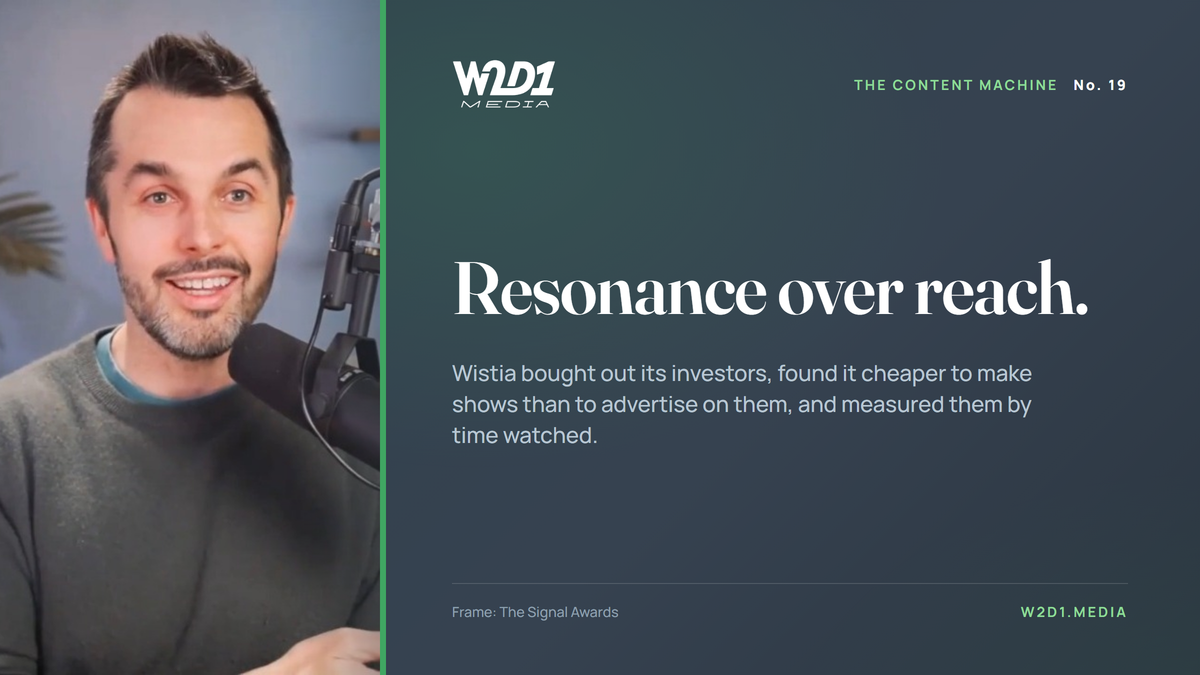
The buyout changed what the content was for. Savage at Business of Software, 2022: after the 2017 deal "we went from negative four to positive six" in annual earnings, and "our revenue growth rate accelerated that right after the buyback". With no exit to sell, the brand became the asset worth building. On 2 October 2019 Savage and Schwartz published "Introducing Brand Affinity Marketing": "an approach to marketing where businesses create and distribute binge-worthy content with the goal of positively impacting the overall sentiment, perception, and value of its brand." The post's rule: "in the modern marketing world, resonance matters far more than reach." And the commitment: "We're going all-in on Brand Affinity Marketing".
Savage gave the economics at the 2022 talk: "it was becoming cheaper to make a podcast than advertise on a podcast, it was becoming cheaper to make a show, than to try to find somebody else's show that you could be on." And the date: "we started doing this stuff in like early 2019."
How the machine works
A studio, with producers. Show Business, launched in April 2021, credits a lead producer, a development producer and a head of production, and the company's 2020 post on "studio mandates" describes a development process borrowed from television. Talking Too Loud launched in January 2021 with "assets such as social posts, audiograms, emails, and promo kit images" for every episode, and a promotion lead working with the design, studios, content, growth and new-user teams.
Each show is its own brand. A 2019 post on sub-brands put the rule: "if you create several series for your brand, you'll probably want each one to have their own unique sub-brand so you can promote them separately to their own distinct niche audiences." Brandwagon's awards entry says it "was hosted primarily on our owned platform, while social media was used to drive users back to our website via trailers and clips, just as a media company would do."
The launch is a campaign with published numbers. For Show Business the company invited "a segment of our database to the hype page twice", aimed at "marketing and production titles from medium-sized B2B companies of 50-200 employees", and reported the two-week result: "9,378 sessions, 8,422 visitors, 570 total trailer plays, and 337 signups" to the show, an email click rate of 10.4 percent against Brandwagon's 5.1, paid social producing 92 of the sign-ups and LinkedIn nearly 45 percent of the social ones. Episodes were cut into 30 to 60 second clips, two-second loops and one-minute trailers, and the series became the company's biggest source of social video views that year.
Retargeting is priced per visit, not per lead. Brandwagon's entry: "Using paid media to distribute trailers and ads", "allowing us to deliver repeat visits to our website for just over $1 per user", and "retargeting those who had watched episode one with teaser trailers of episode two". The total budget was not published.
The yardstick is time. The Brand Affinity playbook's fourth step is "Measuring resonance over reach": "you have to change the way you think about ROI to account for advocacy, rather than just awareness or conversion", with three core metrics, brand search impressions, time watched and subscribers. Brandwagon's entry: "Success was measured in terms of acquired subscribers and time watched per subscriber." Savage, February 2025, on where that leaves attribution: "I think we're entering a period where we marketers need to get more direct human qualitative feedback to understand how our stuff is performing. That requires more comfort with a lack of data, a level of risk-taking, and, in many cases, being an early adopter."
The data report is the one piece built for search. The State of Video report has run yearly since 2021; the 2026 edition says "we surveyed 900+ professionals across industries, dug into over 13 million videos and 79 million hours of viewing data on Wistia". Taylor Corrado, head of brand marketing, said in March 2026 that "For years, the playbook was simple: publish a video on YouTube and let Google take care of the rest. But AI-powered search has changed the game."
What the record does not show: the size of the email list, the promotion budget for any show, episode counts by year, whether any show released an episode in 2026, and the marketing team's size.
What it moves for the business
The figures, with their owners. Savage, 2014: content "the vast majority of our marketing" and "extremely successful". Wistia, 2018: a US$32 million run rate, up 40 percent in a year, profitable again after the buyback. Savage, 2022: earnings from "negative four to positive six", revenue growth accelerating after 2017, and on the shows, "It's all working incredibly well, by the way, we get tonnes of paying customers from all of these channels". Brandwagon's self-reported results after four months: 36,000 views, 6,300 subscribers, an average watch time of eight minutes twenty, 1.2 million views of clips and trailers, viewers "3X more likely to return to wistia.com than non-viewers", and a "4% increase in Branded search volume year-over-year". Greg Head's Practical Founders podcast in March 2024 described the company as "very profitable" with 180 employees, in the host's words.
The limits. The paying-customers line is a conference auto-transcript, with no number, no method and no cost attached. Brandwagon's results are an awards entry written by Wistia, and they stop at return visits and branded search; no sign-up or revenue figure is given for any show except the documentary covered elsewhere. The 2014 "no sales team" claim is stale: by 2019 a third-party interview counted sixteen quota-carrying reps, and the site now carries a "Talk to Sales" link. The company cut about 40 people, a fifth of its staff, in November 2022, per The Pragmatic Engineer. And the measurement is the point of contention: a company that chose time watched over leads cannot, by design, tell you what a show is worth in pipeline. Savage says that is the right trade. The record lets you believe him without letting you check.
What to steal
Make the show instead of buying the slot. Savage's arithmetic in 2019 was that a podcast cost less to make than to sponsor. Run the same sum on your own category before you buy another placement.
Give each series its own brand and its own list. Sub-brands let Wistia aim each show at a niche and count its subscribers separately. One company brand with everything under it hides what is working.
Publish the launch numbers. Sessions, trailer plays, sign-ups, email click rates, by channel. Wistia did it for a two-week window. Do it once and you will never again guess which channel to fund.
Price the repeat visit. "Just over $1 per user" for someone who comes back to watch episode two is a number most marketing teams never compute. Compute it.
Choose your yardstick, then live with its blind spot. Time watched tells you about affinity and nothing about pipeline. If you pick resonance over reach, write down what you are giving up, so that nobody is surprised in the budget meeting.