
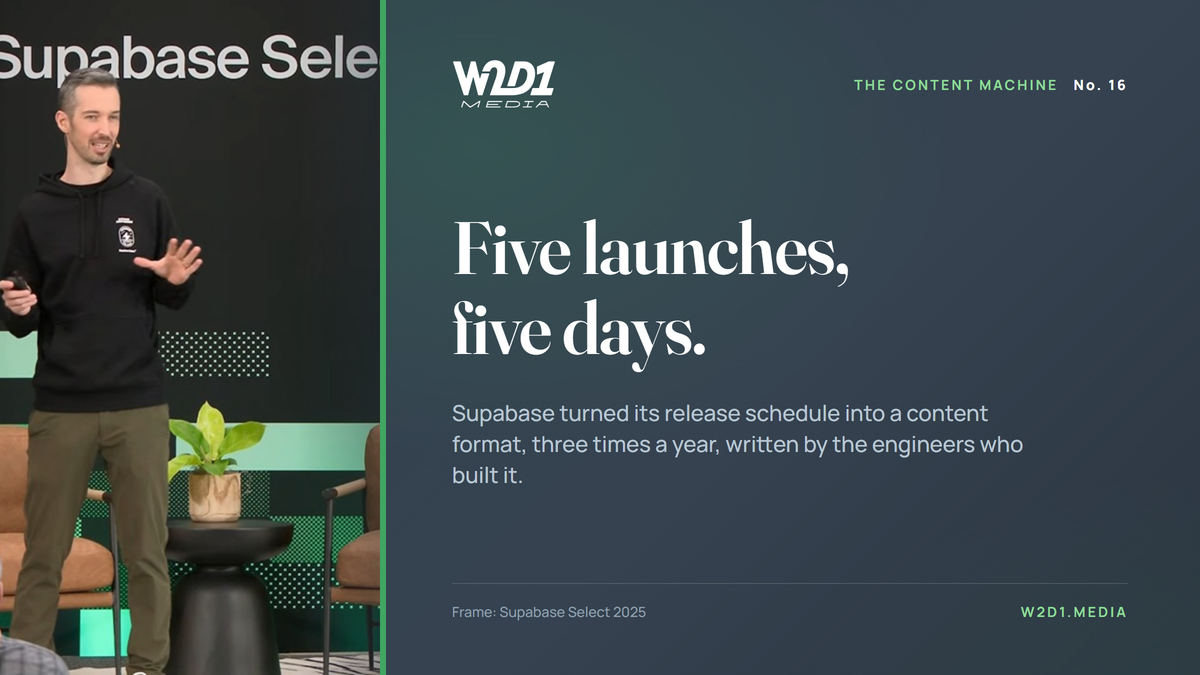
Supabase ships one feature a day for five days, three times a year, and calls it Launch Week. The engineers who build each feature write its post. The company says that rhythm was a key part of growing the databases it manages 47 percent month on month for eighteen months, and investors have since valued it at US$10 billion. The honest part is what its chief executive said in 2025: the launch weeks now run for an internal reason, to make engineers announce what they shipped. Here is the machine, dated.
The Content Machine is a column about startups and scaleups that run content as a system: what they make, how often, how it is reused, where it goes, who makes it, how it is measured and what it moves for the business. Supabase is here because it built its content system out of its release schedule rather than beside it, and because the company has written down how it works. Every figure is attributed to the person or document it came from, and the company's own numbers are labelled as the company's.
The premise
Supabase is an open-source developer platform built on the Postgres database: a hosted database, authentication, storage and functions that a developer can wire to an app in an afternoon. Paul Copplestone and Ant Wilson founded it in 2020 and took it through Y Combinator that northern summer. It has since raised, by its own and press accounts, US$30 million in October 2021, US$80 million in May 2022, US$80 million in September 2024, US$200 million at a US$2 billion valuation in April 2025, US$100 million at a US$5 billion pre-money valuation in October 2025 and US$500 million at US$10 billion pre-money in June 2026, the last led by GIC and reported by TechCrunch. The company has published no revenue figure.
The machine, in one paragraph. Three times a year the company announces one feature a day from Monday to Friday, each with a post written by the engineer who built it, and closes the week with a top-ten summary. Around the week sit a hackathon, community meetups, personalised tickets, a Product Hunt listing on the morning of each launch, and, in December 2022 and October 2023, a "Content Storm" in which thirty to forty outside creators published Supabase content on the same day. In between, the blog runs at a fraction of the launch-week rate, the documentation is treated as part of the product, and a monthly developer update goes out on GitHub. The one piece to look at is the company's own account of how it launches, written the week before its third Launch Week in 2021, which is also where the growth claim lives.
How it started
The first launch was an accident. Ant Wilson told Felicis in September 2026 that "We weren't even really prepared to do a formal launch" when an early user posted the site to Hacker News in May 2020: "The community launched us." Copplestone's October 2021 Series A post reports what the following eighteen months produced: "As of September, we've launched over 50,000 databases", "over 40,000 developers have signed up", "Active databases are growing 35% per month", and "Our growth is all organic."
The format came from a deadline. Wilson's post of 25 March 2021 says the team had spent its Y Combinator batch building authentication, set itself three months to reach beta, and then chose "a full week of launches" rather than one announcement: pricing on the Monday, storage on the Tuesday, a command-line tool on the Wednesday, a component library on the Thursday, connection pooling and a domain change on the Friday. "Starting on Monday 29th March, we'll be commencing our Launch Week!" By November 2021 the company was about to run its "third Launch Week this year", and Wilson wrote the post that explains the method.
How the machine works
The engineer who built it writes it. From the November 2021 post: "the person who implemented the code will be the same person who writes the marketing content." And: "Full write-ups, marketing copy, and broad Top-of-Funnel type marketing efforts will often happen during Launch Week to hype up these features." Wilson's December 2022 hiring post says projects move "to marketing and launch without a single synchronous meeting", and that "it's important that we view docs as part of the product itself and not a byproduct". The company was "60 people spread across 25 different countries" when he wrote that.
Three weeks a year, one feature a day, a wrap on Friday. The dated record runs from Launch Week 1 in March 2021 through Launch Week 5 starting 15 August 2022, 6 in December 2022, 7 in April 2023, 8 in August 2023, 12 in August 2024, 13 in December 2024, 14 in March 2025 and 15 from 14 to 18 July 2025. Roughly every four months. The week ends with a post like the one for Launch Week 15: "Here are the top 10 launches from the past week." By a count of the company's own RSS feed, launch months carry twelve to eighteen posts and quiet months one to six, so the week is where most of the year's writing happens.
The launch day is a checklist. The 2021 post publishes it: "7:55am Product Hunt goes live", a tweet shared with the company's angel investors, and a Hacker News post. For the component library in the first week the team "made sure it ranked on Product Hunt, and reached out to some friendly designers to help boost our message."
Outside creators are scheduled, not hoped for. The December 2022 Content Storm, run by growth marketer Ramiro Nunez Dosio, recruited "well-known YouTubers, community members, builders using Supabase, SupaSquad members" to publish on one Tuesday ahead of Launch Week 6; the post lists 32 pieces from more than 30 creators. The October 2023 edition had "More than 40 creators". Neither post reports a result. The SupaSquad programme behind it offers four tracks, contributor, content creator, trusted host and event speaker, and "A path from volunteer to paid contributor to paid employee."
What they count. The 2021 post: "The more direct a connection between actions and metrics the better, so it's important to remind everyone of what the north star is." The Series A and B posts report databases, developers, Discord members, Twitter followers and GitHub stars, with the Series B giving the pairs: Discord 4,000 to 8,000, Twitter 18,000 to 37,000, GitHub stars 19,000 to 36,000. The company has not published a share of sign-ups from any content, a cost per developer, or a revenue figure.
Why it still runs. Copplestone told the Evil Martians podcast in November 2025: "The main thing that I think why we do it internally now is because it's still a good forcing function." And: "If you leave developers unchecked, they probably won't just keep shipping and never announce what, what they've done." The content format outlived its marketing purpose because it is also the release process.
What the record does not show: the size of the developer relations or marketing team, any paid sponsorship of creators, and any attribution between launch weeks and sign-ups.
What it moves for the business
The figures, with their owners. Wilson, 26 November 2021: Launch Week "is a key part of a Product-Led Growth strategy that has enabled us to increase the number of databases we manage 47% month-on-month for the last 18 months." The same claim, restated in December 2022 as "46% month-over-month for the first 18 months". Copplestone, August 2022: "As of today, we've launched over 150,000 PostgreSQL databases" and "Today we have more than 110,000 developers." Fortune, April 2025, reporting the US$200 million round: two million developers and more than 3.5 million databases. TechCrunch, June 2026: "nearly 10 million developers" and "Database launches on Supabase have grown over 600% in the past year", with more than 60 percent launched through AI coding tools.
Then the cause the chief executive names most clearly. Copplestone told Fortune in April 2025: "Our sign-up rate just doubled in the past three months because of vibe coding." The app builders Lovable and Bolt, and later the coding agents, chose Supabase as a default backend, and the company's growth since late 2024 is described by its founders in those terms, not in terms of content.
The limits. The 47 percent is databases, not customers or revenue, it is self-reported, and the sentence credits a whole product-led strategy of which launch weeks are "a key part". No source splits the credit. Supabase has never published revenue, and the third-party estimates in circulation are not used here. The content storms report nothing. And by the founders' own account, the machine that built the first 110,000 developers is not what carried the company to ten million; the AI wave did that, while the launch weeks continued as the way the company ships.
What to steal
Make the release the content. Supabase did not add marketing to its roadmap. It shaped the roadmap into five days a developer would follow. If you ship, your calendar is your content calendar.
Let the builder write it. The engineer who built the feature wrote the post. It cost an afternoon and it read like the truth. The marketing team's job was the checklist around it.
Fix the cadence and publish the dates. Three weeks a year, announced ahead. The audience learned when to look, and the engineers learned when the deadline was.
Schedule the community. Thirty creators on the same day is a programme, not luck. Give them the date, the assets and a reason, and count what they publish.
Keep the format when the reason changes. Launch Week began as marketing and survives as a forcing function. If a content habit still makes the company better at shipping, keep it even after the attribution fades.