
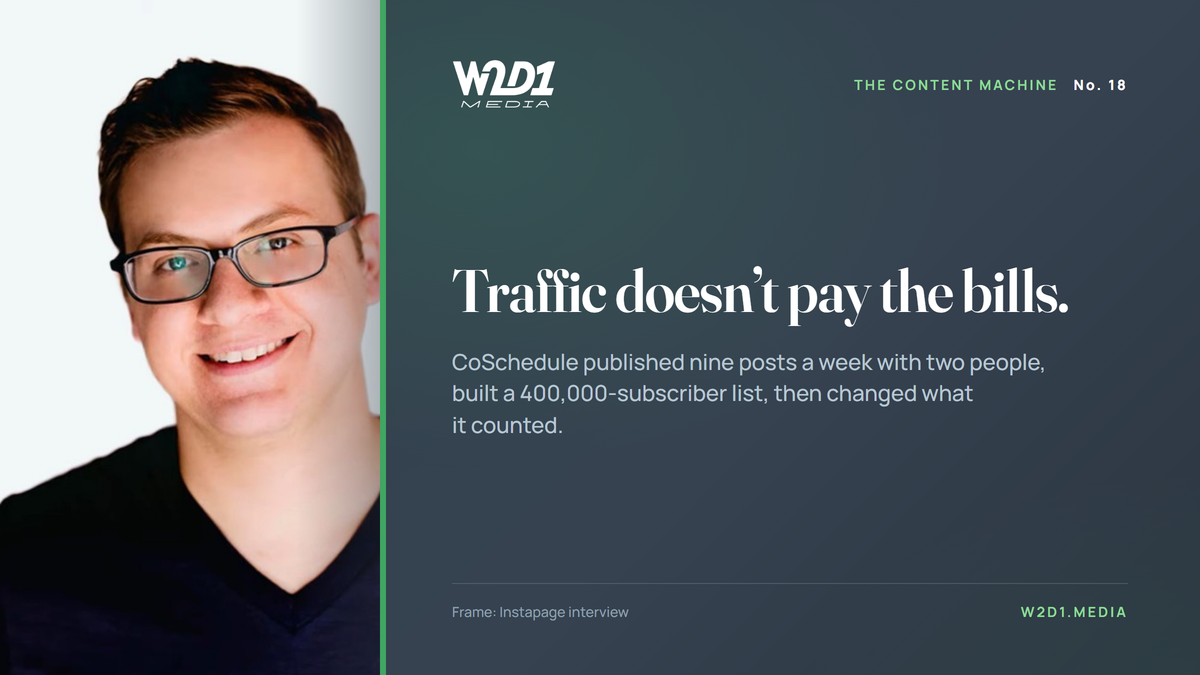
CoSchedule sells a marketing calendar from Bismarck, North Dakota, and for most of a decade it ran the most prolific blog in its category: eight or nine posts a week with two people, a free headline tool used by more than a million marketers, a podcast past 300 episodes, and courses taught by the blog's own writers. The chief executive called content "the number one driver of growth". Then the inbound director said the sentence every content team eventually says: "traffic doesn't pay the bills." Here is the machine, and what it changed.
The Content Machine is a column about startups and scaleups that run content as a system: what they make, how often, how it is reused, where it goes, who makes it, how it is measured and what it moves for the business. CoSchedule is here because it sold a content calendar to content marketers and ran the loudest possible demonstration of one, and because its own people have described, in public, both the volume years and the day they stopped counting traffic. Every figure is attributed to the person or document it came from.
The premise
CoSchedule makes marketing calendar software, a headline tool and a set of marketing courses. Garrett Moon and Justin Walsh founded it in Bismarck in 2013; Moon is chief executive. The company raised a US$500,000 angel round in 2014, announced on its own blog, and has reported no later round from a primary source. Its about page now says "Fully remote since March 2025" and lists fifteen people. The firmest business figures are old: a writer for Side Hustle Lab reported in August 2018 that CoSchedule "generates over $5 Million in Annual Recurring Revenue" with "over 8,000 paying customers" and "more than 400,000 subscribers on their blog", and the company's Inc. 5000 debut that year, at number 153, carried 2,771 percent three-year revenue growth.
The machine, in one paragraph. A blog that at its peak published eight or nine posts a week, educational pieces on Monday, Wednesday and Friday and product posts between, with a podcast every Tuesday and a companion post for each episode. Every post sat on the company's own calendar product, which was the point. Around it: a free headline analyser that the company now says is "Trusted By More Than 1 Million Marketers", an Actionable Marketing Institute with 30 courses taught by the blog's writers at US$99 each, an annual State of Marketing Strategy survey, and a chief executive's book. The one piece to look at is the Headline Studio page, because the free tool is the ladder from reader to paying user.
How it started
Moon told Mixergy in December 2014 how it began: "I just started writing five blog posts a week." The data for the headline tool came from a guest post he wrote after analysing about a million headlines. Asked on the SaaS Club podcast whether the blog was the primary way the company acquired customers, he said "It's one of the main ones, yes." and then "I would say by and large that has been the number one driver of growth for us". The host's introduction to that episode put the company at "over 100,000 blog subscribers, 7,000 paying customers, and a seven figure SaaS business." Moon also said the company "self funded for at least for over a little over a year" before the angel round.
The list was the asset. By July 2017 Nathan Ellering, who ran marketing, told the company's own podcast that CoSchedule had "grown our audience to about 200,000 email subscribers and 2 million or more page views every single month". Moon, on the same podcast in March 2018, described "going from 0-300,000+ subscribers on our email list in just a few years", and told Side Hustle Lab that year: "The best investment we've ever made is starting and growing our email list."
How the machine works
Nine posts a week from two people. Ellering, July 2017: "We publish up to, just blog posts alone, I think eight to nine blog post every single week" and "we do that with a team of basically two that work on the blog". Ben Sailer, then blog manager, had said two months earlier that "We're publishing content, at this point, every day." The team around the blog, by Sailer's wider count, was "about eight people" including writers and a designer. The two numbers describe the same operation drawn at different edges.
Nothing ships off the calendar. Sailer, May 2017: "We will never publish anything that doesn't go on our content calendar." The rule was to hold "a consistent two weeks' worth of content that's completed ahead of time" and to plan two to three months out. The company ate its own product in public, which is as good a demonstration as a software company gets.
Everything becomes something else. Posts became templates, templates became gated downloads, downloads became email courses, and the courses became a paid institute. The institute's own page says its instructors are "the CoSchedule experts behind our blog", and it launched in January 2018 with the line "12,193 students later, it's finally here." The podcast gave each episode a companion post and passed 300 episodes by April 2022, when it was running "best of" reruns.
The free tool is the top of the funnel. The headline analyser, rebuilt as Headline Studio in January 2021, had "more than 45,000 users" within four months by the company's own release, and the page now claims more than a million. There is no public figure for how many of them paid for anything.
The day traffic stopped being the measure. Sailer told Databox's podcast in March 2021: "For a long time at CoSchedule, the goal of inbound and organic marketing, SEO, social, email, was just to increase traffic and build our email list. And then we'd figure out how to monetize that list later." And then: "traffic doesn't pay the bills. An email list, by itself, doesn't pay the bills." The change was to work out, "of the hundred of blog posts that we published, which are the ones that actually have a close connection to a product?", rewrite their calls to action, and count readers who reached a product page. "Since we started tracking this, we've seen extremely high conversion rates." He put it at "probably around 30 percent". That is readers of selected posts reaching a product page, not trials, and he said so by describing it that way.
What the record does not show: posts per month after 2017, any trial or revenue figure tied to content, and what happened to the blog. Its live index, read on 16 October 2026, shows the newest post dated December 2023, and the company has said nothing about why.
What it moves for the business
The figures, with their owners. Moon, SaaS Club: content "the number one driver of growth for us". The host's count at the time: 100,000 subscribers, 7,000 paying customers, seven-figure revenue. Side Hustle Lab, August 2018: more than US$5 million in annual recurring revenue, more than 8,000 paying customers, more than 400,000 subscribers. CoSchedule's own 2018 book launch post: the company "grew from zero to over 8,000 customers in less than four years." Inc., 2018: number 153, 2,771 percent growth. Sailer, 2021: about 30 percent of readers on mapped posts reaching a product page.
The limits. No one at CoSchedule has published a count of trials, customers or revenue that came from content. The chief executive's claim is qualitative and undated on the page that carries it. The strongest figure is a product-page rate, not a sale, and Databox's own headline on that interview overstated it as a 30 percent rise in trials, which the body of the piece never says. The revenue figures stop in 2018. And the machine itself appears to have stopped: a blog that ran daily now shows nothing newer than December 2023, while the courses, the tool and the survey continue. CoSchedule has not explained the change, so I will not guess at it beyond noting that Moon said in 2018 that "You actually make less traffic but the business value can go up exponentially."
What to steal
Eat your own product where people can see you. CoSchedule's content calendar was the demonstration of its content calendar. If your product is a process, run the process in public.
Keep two weeks in the bank. The rule was fourteen days of finished posts ahead at all times. Volume without a buffer is a week from collapse.
Map every post to a product page before you count a view. Sailer's change was to ask which posts had "a close connection to a product" and measure only those. Do it before the hundredth post, not after the thousandth.
Turn the writers into teachers. The institute's instructors were the blog's authors. The same expertise sold twice, once free and once at US$99.
Say the sentence early. "Traffic doesn't pay the bills" came after years of a 400,000-subscriber list that sales "didn't seem to be tracking with". Write the sentence on the wall in year one.