
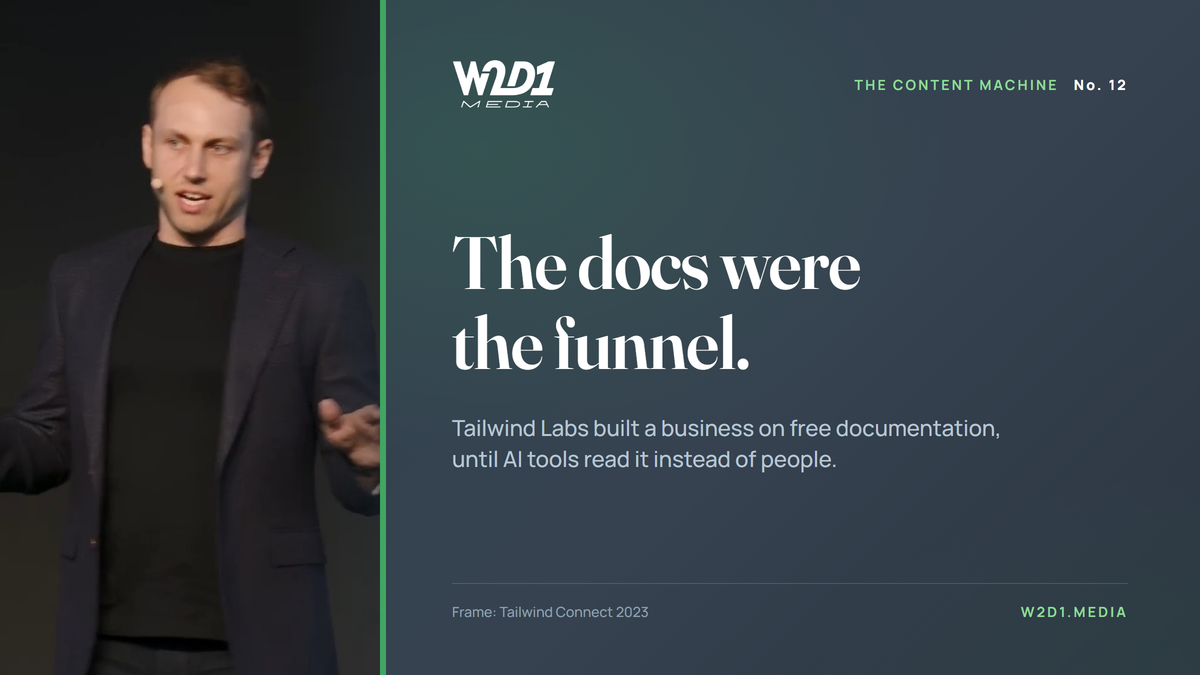
Tailwind Labs never ran a marketing department. Its founder taught a CSS framework in public, sold a book and a component library to the people who learned it, and said in 2020 that teaching "has been the most effective way to grow the business". In January 2026 he said traffic to the docs was down about 40 percent, revenue was down close to 80 percent, and three quarters of the engineers had lost their jobs. In September it joined Shopify. Here is the machine, and the failure, in his words.
The Content Machine is a column about startups and scaleups that run content as a system: what they make, how often, how it is reused, where it goes, who makes it, how it is measured and what it moves for the business. Tailwind Labs is here because it is the clearest case I have found of a content funnel that was the entire business, and because its founder has described, in public and with numbers, both the years it worked and the year it stopped. Every figure is Adam Wathan's own unless I say otherwise.
The premise
Tailwind Labs makes Tailwind CSS, a free, open-source framework for styling websites, and sold the commercial products around it: Refactoring UI, a book and video course on design for developers, and Tailwind UI, later Tailwind Plus, a library of paid components. Wathan and his design partner Steve Schoger founded it in Ontario, Canada; the framework's first release was in November 2017, Wathan went full-time at the start of 2019, and the company took no outside money that I can find. On 9 September 2026 Wathan announced that Tailwind was joining Shopify, on undisclosed terms, confirmed by BetaKit and CMSWire the same week.
The machine, in one paragraph. The framework is free and installed, by Wathan's September 2026 count, more than 110 million times a week. Learning it means reading its documentation. The documentation is the only place the paid products are mentioned, through a single link in the navigation. Around that funnel sat a podcast Wathan had run since before the framework existed, a YouTube channel of screencasts, Schoger's design tips on Twitter that became the book, and a book launch that paid for the company's first years. There was no sales team, no advertising and, as far as the record shows, no content calendar. The documentation is the content; it is the one piece to look at.
How it started
Before Tailwind there was teaching. Wathan hosted a podcast, Full Stack Radio, from 2015, 153 episodes by 2025, with no sponsors; the show's own description asks listeners to buy the hosts' products instead. The first episode was a conversation about CSS semantics with Matt Stauffer; the show's audience was the Laravel and front-end community that later became the framework's first users. By the time the framework shipped, its author had been talking to its buyers, for free, for two years. In April 2017 he wrote up a book launch that made US$61,392 and let him quit his job. The framework began as the leftover stylesheet from an abandoned side project with Schoger in 2015, was discussed on episode 71 of the podcast, and shipped in 2017.
The commercial model arrived with Refactoring UI in December 2018: Schoger's design advice, which the pair had been giving away on Twitter, packaged as a 218-page book with screencasts and assets at US$99 or US$149. Wathan has said it gave him "a big bankroll" and the confidence to go full-time on the framework, and the book's own page now claims more than 30,000 copies sold. That is the pattern of the whole company. Give away the thing people need to learn, sell the thing they want once they have learned it.
How the machine works
The documentation is the funnel and the product. Wathan's year-in-review for 2020 put it plainly: with "the Tailwind CSS documentation acting as an incredible distribution channel for us, sales have actually slowly trended up." And: "teaching more people how to use the framework has been the most effective way to grow the business." The docs are written by the engineers who build the framework, which is why they are good, and they carry one link to the paid products, which is why the funnel converts without a sales call.
The paid products are the lessons, finished. Refactoring UI is the design advice, finished into a book. Tailwind UI is the framework, finished into components. Each paid product is the free content taken one step further than a reader could take it alone. Wathan's figures for 2020: the Tailwind UI launch was "the biggest launch we've ever had ($400,000 on the first day)", Refactoring UI "did about $600,000 in 2020", Tailwind Labs had "done over $4m in revenue in under 2 years" by August 2020, and the company was "reliably doing mid-seven figures per year" by that December, with a team that went from two to four full-time people in the year.
The podcast and the screencasts are the long tail. Full Stack Radio ran irregularly, 21 episodes in 2020 against a historical fortnightly pace, and the YouTube channel launched the same year. Neither was scheduled content in the sense this column usually means. They were the founder teaching when he had something to teach, and selling nothing but his own products at the end.
One in-person event, filmed. Tailwind Connect in 2023, in Wathan's hometown of Cambridge, Ontario, drew more than 200 people and four hired videographers, and was where the company previewed its next engine and component kit. One event in nine years. The content came from the product work, not from an events calendar.
Measurement was traffic against sales, by the founder's eye. There is no attribution model in the record. Wathan watched documentation traffic and watched revenue, and in 2020 noted they moved together. In 2026 he noted they moved together the other way.
What the record does not show: any repurposing pipeline, any newsletter, and any content cadence. This was never an editorial programme. It was a product whose documentation was its marketing, run by people who could write.
What it moves for the business
The years it worked, in Wathan's figures: US$4 million in under two years, mid-seven figures a year by 2020, a US$400,000 launch day, a US$600,000 year for a book. A profitable company of four, built on free documentation and no marketing spend.
Then the year it stopped. On 7 January 2026, in a comment on a pull request proposing to make the docs easier for AI tools to read, Wathan wrote: "Traffic to our docs is down about 40% from early 2023 despite Tailwind being more popular than ever." And: "The docs are the only way people find out about our commercial products, and without customers we can't afford to maintain the framework." And: "Tailwind is growing faster than it ever has and is bigger than it ever has been, and our revenue is down close to 80%." The day before, "75% of the people on our engineering team lost their jobs", leaving the co-founders and two engineers. DevClass reported his warning that without a change the company would be unable to meet payroll within about six months, and, two days later, that Vercel and Google AI Studio had announced sponsorships. In September the company joined Shopify, and Wathan wrote that "we'll no longer be trying to grow the business around Tailwind"; new sign-ups for the paid products closed.
Read those two paragraphs together and the lesson is exact. The framework's usage went up. The documentation's traffic went down, because developers were getting the answers from AI tools that had read the documentation instead. The paid products were only ever visible from the documentation. A content machine with one channel, when that channel is read by a machine instead of a person, loses the customer and keeps the cost.
What to steal
Sell the finished version of what you teach. The book was the free tips, finished. The components were the free framework, finished. If your content teaches something, the product is the thing a reader cannot finish alone.
Let the people who build the thing write the documentation. Tailwind's docs converted because engineers wrote them. A content team that cannot use the product cannot write the piece that sells it.
Give away the whole lesson and sell nothing in it. No sponsors on the podcast, one link in the docs. The restraint was the trust, and the trust was the conversion.
Know which single page your revenue depends on. Tailwind's was the docs. When a reader stopped visiting it, there was no second route to the paid products. Build the second route before you need it.
Watch what reads your content, as well as how much. Wathan's traffic fell 40 percent while usage rose. The readers had become AI tools. If your content is being consumed without being visited, your funnel has already changed, whether or not your dashboard has.