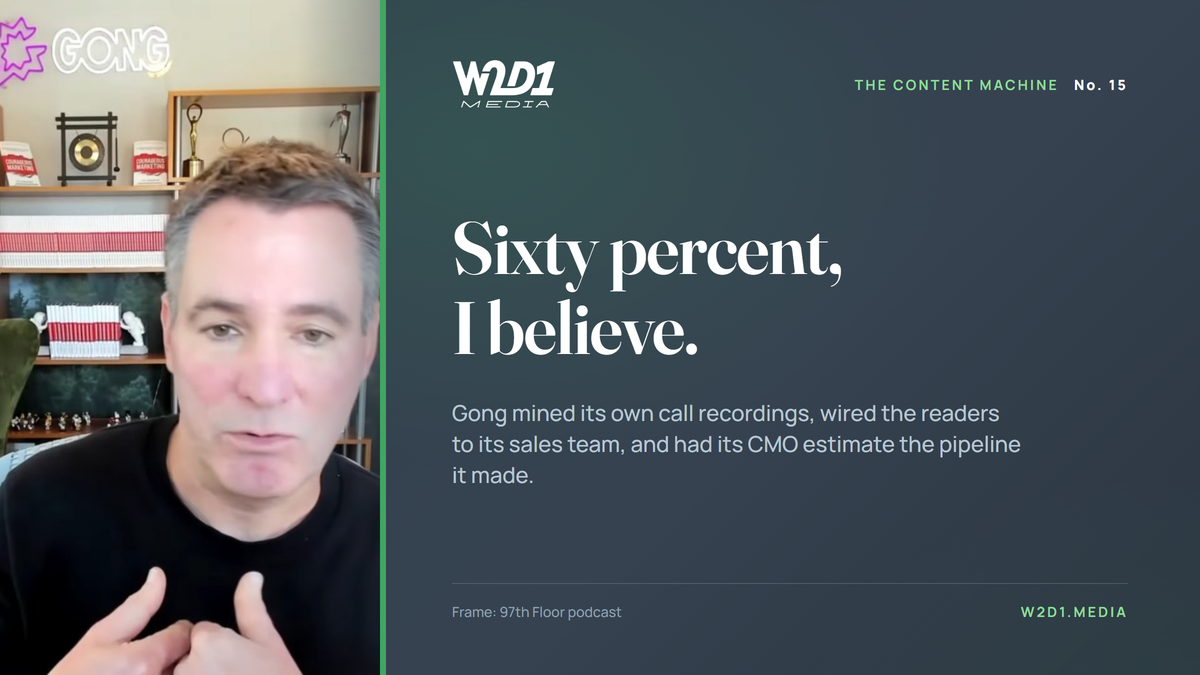
Gong records sales calls for a living, so its content team mined the recordings and published what the best salespeople do differently. One ungated article got thousands of shares in a week, the chief executive asked for another every fortnight, and a hundred studies later Gong Labs still runs. The part most companies miss is the wiring: whoever reads the research at a target account triggers a salesperson. In 2020 the CMO put that at about 60 percent of pipeline, hedged with "I believe". Here is the machine, in his words.
The Content Machine is a column about startups and scaleups that run content as a system: what they make, how often, how it is reused, where it goes, who makes it, how it is measured and what it moves for the business. Gong is here because it is the clearest case I have found of content that was never meant to be read and forgotten. Every study was built to trip a wire in the sales process, and the person who built the wiring described it on a podcast with a number attached. Every figure is attributed to the person or document it came from.
The premise
Gong sells revenue intelligence software: it records and transcribes sales calls, emails and meetings, then tells sales teams what is working. Amit Bendov is the chief executive. Udi Ledergor joined in 2016 as the first marketer, became chief marketing officer, and is now the company's chief evangelist; Emily He has been chief marketing officer since May 2024. Gong raised US$250 million at a US$7.25 billion valuation in June 2021, per TechCrunch, said in March 2025 that it had passed US$300 million in annual recurring revenue, and announced a US$500 million run rate in May 2026, per Calcalist.
The machine, in one paragraph. Gong's data science team cuts its own call recordings into findings, the content team writes them up as Gong Labs studies, and those studies go out through the company's LinkedIn page, its email list and its webinars. Anyone at a target account who downloads or attends is flagged to a sales development representative within minutes. Around the research sits a podcast, a yearly conference, a purple brand loud enough to buy regional Super Bowl ads, and a founder-era habit of searching Gong's own call recordings to see which marketing a prospect mentions. The one piece to look at is a Labs study published this month, which finds that win rates rise 30 percent when four or more people on the buying side speak up in a deal.
How it started
Ledergor told the story to the Mighty & True podcast in July 2025. He was curious what happened when salespeople swear on calls, had an analyst run the numbers, and found "an 8% higher win rate if they swear on sales call with certain stipulations." That became a story. "My first hire to my team was Chris Orlov, who basically created and took over the Gong Labs data series content series, and it's still running today, nine years later."
Chris Orlob told his side on the Dock podcast in January 2024. In his first week he found a gated ebook: "we analyzed 25,000 sales calls. Here are five things the best salespeople do differently." He thought it would travel if it were free. "I emailed Udi and Amit. I'm like, can I turn this into an article? They're like, yeah, go for it. I wrote this article over the weekend." They published it on Sales Hacker, "and it got thousands of shares immediately." Then the instruction that turned a post into a programme: "Amit is like, I want to see an article like this every two weeks." The company hired a data science firm to feed it. "100 articles later, they're still going with that."
By September 2020, when Ledergor sat down with the Demand Gen Visionaries podcast, he could describe the whole system. "We were probably the first company to come out with consistent data backed content that showed sales teams, what is working and what isn't working so they could get better consistently." And: "that has been our content strategy for the last four years."
How the machine works
The data is the product's, and the output is short. Gong Labs, the company's own page says, turns "billions of sales conversations, deals, and workflows into insights" drawn from "5,000+ companies", and "We publish new research monthly." Ledergor's 2020 rule for the format: "I'd say 99% of our content takes. Less than five minutes to consume." Devin Reed, then head of strategy, told Workello in February 2022 that a study takes "Typically 4-6 weeks from idea to publication."
The reader trips a wire. This is the part of the system that justifies the instalment, in Ledergor's own words from 2020: "we create thousands of MQL or marketing qualified leads every month, by looking at who's consuming our content and attending our webinars, downloading our eBooks. And if they're the right person at the right target account, that will trigger an alert to an outbound SDR who can then start a conversation with that prospect." The plumbing behind it: "probably a dozen systems that we've stitched together in custom ways to optimize the inbound and outbound lead flows, to make sure that we can respond to a lead within minutes of them coming in or consuming a piece of content."
LinkedIn first, because it is free. In 2020 the company page had "like 42,000 followers", "all of those are organic", and Ledergor called it "my cheapest demand gen channel because. We get a ton of engagement when we post a good article on LinkedIn and then link from that to a download of a premium content piece that asks for people's email, we can get thousands of downloads in a day and that doesn't cost me a dime." Reed's 2022 version of the rule: "The goal is to grow our following with 'brand content' (no CTA)" to earn trust, then "sprinkle in demand gen content (gated, event sign ups, etc) to fuel pipeline gen". The interview that quoted him was headlined on the page growing from 12,000 to 90,000 followers in two years. By July 2025 Ledergor said the page was about to pass 300,000.
Three channels, one team of twelve. Ledergor named the channels he could not do without in 2020: "our LinkedIn page, ... our email list and our virtual events slash webinars". The team then was twelve people, "The larger one with eight people on it is the demand gen team", including a data scientist who surfaces the stories, two in marketing operations, one on events, one on account-based marketing and one digital marketer. The company had 350 employees. Reed listed the content pillars in 2022: organic social, email, sales research and LinkedIn articles, webinars, sponsored content, the podcast and growth marketing.
Brand spend is measured by searching the call recordings. Gong ran a regional Super Bowl ad in 2021 and again in February 2022; its own blog says the first one "helped create the company's biggest-ever sales pipeline", a claim the company made about itself. Calcalist reported the 2022 ad at about US$1.5 million; Ledergor said in 2025 that he "ran a Super Bowl commercial for less than $300,000", and I give both because they do not agree. His measurement method is the memorable part. After his chief executive appeared on a Michael Lewis podcast: "I opened up Gong and I searched for Michael Lewis podcast and, lo and behold, I found 40 customer calls where people came on a demo and, unprompted for it, said I heard your CEO on the Michael Lewis podcast". After the Super Bowl: "I found hundreds of sales conversations where they said, oh, I saw you on the big game last night."
What they count. Reed, 2022: "We split it between brand and performance marketing." Brand is podcast consumption and LinkedIn follower growth; performance is "MQLs, SAOs, pipeline sourced and influenced across the entire sales org and each segment". Ledergor, 2020, on the limits: "Don't even get me started on, you know, attribution and things like that."
What the record does not show: the number of Labs studies published, Reed's departure date, the exact date Ledergor stepped out of the CMO role, and any restatement of the pipeline split after 2020.
What it moves for the business
The figures, with their owners. Ledergor, September 2020, on the content-triggered outbound motion: "that I believe creates about 60% of our opportunity pipeline". On the inbound side, the same content sends buyers to the website, "And that's what brings in about 40% of our pipeline. For some context in Q 2 the last quarter that ended, we have North of 3000 inbound demo requests on our website. Most of them a result of the content strategy that I just explained." The company then had "about 1300 customers with I think 65,000 users using gong every day."
Around that sit the business numbers. Bendov told TechCrunch in June 2021 that annual recurring revenue had grown 2.3 times year on year at the US$7.25 billion round. Gong's own release of 5 March 2025: it "surpassed $300 million in ARR for fiscal year 2025". Calcalist, 12 May 2026: a US$500 million run rate "after posting year-over-year growth of more than 55% in the last quarter." In February 2023 Bendov cut 80 roles, about seven percent of staff, and wrote that "We are not making any reductions in R&D, product, or marketing."
The limits. The 60/40 split is one man's estimate on one podcast six years ago, hedged with "I believe", about opportunity pipeline rather than revenue, and Gong has not restated it. The sponsor's summary on the episode page dropped the hedge, which is how the shortlist first met it as a flat fact. The Super Bowl pipeline claim is Gong's own, unquantified. The call-search method is honest about what it finds and silent about what it misses. And the company that started with a twelve-person team and no attribution now has a US$500 million run rate and a chief marketing officer from Microsoft, so the machine described here is the one that built the company, not necessarily the one running it today.
What to steal
Publish the data only you can see. Gong's edge was recordings nobody else had. Find the dataset your product generates and write the first study this month.
Ungate the finding, gate the next step. The 25,000-call ebook sat behind a form until Orlob rewrote it as a free article. The shares came from the open version; the leads came from what it linked to.
Set the cadence from the top. "I want to see an article like this every two weeks" is a chief executive's sentence, and it created a nine-year programme. Decide the interval and assign the data person.
Wire the reader to the seller. The content did not generate leads so much as signals. A download by the right title at the right account became a conversation within minutes. Build that path before you scale the publishing.
Search your own calls. Gong measured its podcast placement and its Super Bowl ad by counting the prospects who mentioned them unprompted. If you record sales calls, that report costs you nothing.