
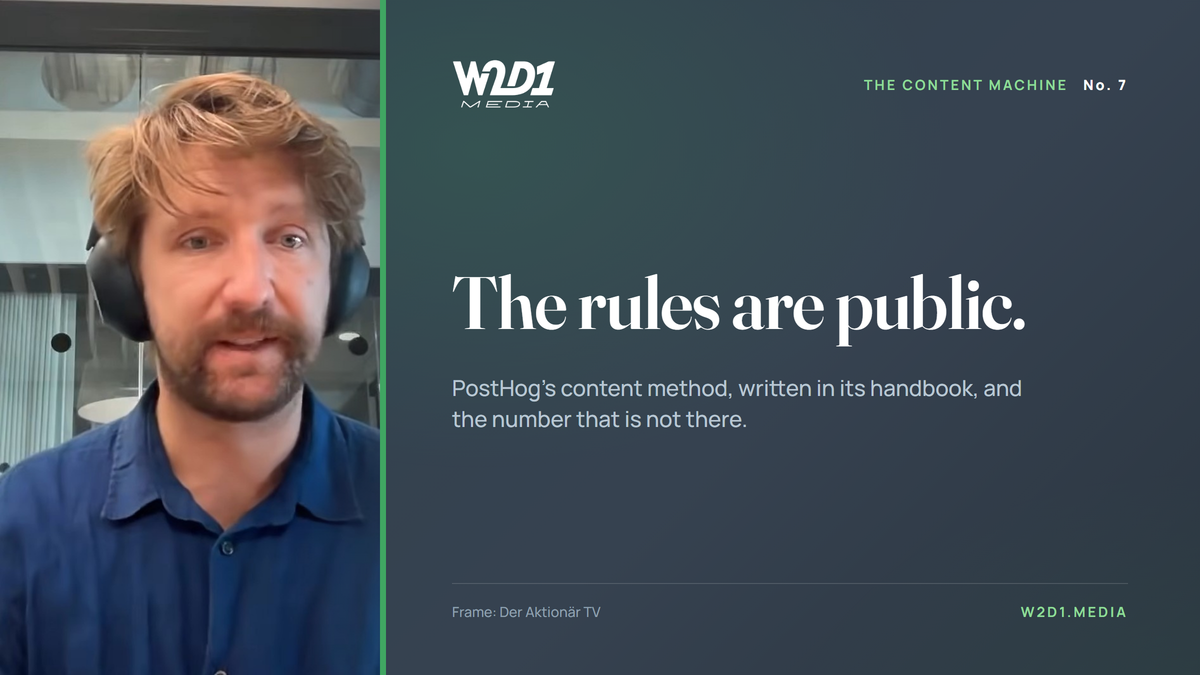
PostHog's content operation is written down in public. No arbitrary volume goals, no freelancers, nothing written by AI, shares as the measure, and a newsletter that went from 38,000 to more than 100,000 subscribers in a year. The founder once moved paid ad budget to hire another writer. What the public record does not contain is a number joining any of that to revenue, and the piece says so.
The Content Machine is a column about startups and scaleups that run content as a system: what they make, how often, how it is reused, where it goes, who makes it, how it is measured and what it moves for the business. PostHog is here because it is the one company in the column whose machine you can read in full without an interview. Its handbook is public and its content pages are part of it. The trade is that PostHog publishes its method far more readily than its results, and I have not filled the gap with guesses.
The premise
PostHog sells product analytics and the tools that sit beside it, session replay, feature flags, experiments, open source and self-hostable. It was founded in January 2020 by James Hawkins and Tim Glaser, went through Y Combinator's winter 2020 batch, and raised a US$70 million Series D in June 2025 at a valuation the company put at about US$920 million, followed by a US$75 million Series E in October 2025 at about US$1.4 billion, per its own announcements. In October 2024 the company described its revenue as "in the low $10s of millions of ARR". Headcount went from 38 in December 2022 to about 65 in October 2024, about 140 in October 2025 and about 200 in early 2026, per its own pages, so the content rules were written for a company a fifth of its current size and have survived the growth.
The machine, in one paragraph. A small in-house team of writers and engineers produces a blog, a newsletter now called build mode, documentation and tutorials, under rules the handbook states plainly: no arbitrary volume goals, no freelancers, no AI-written content, and content described as "the main pillar" of marketing. Shares are the measure. The newsletter is built from the blog. The whole thing is meant to make PostHog the company engineers tell each other about, which the handbook calls growth "driven primarily by word of mouth, rather than paid ads or PR", on the same page where it says "We run a lot of paid ads". The one piece to read is Running content at PostHog, from 2021, which set the rules the current handbook still carries.
How it started
The 2021 post, by Mo Shehu, is the founding document. It set a floor of "at least 2 pieces a week", named shares as "the strongest indicator of resonance", and described a company that wanted to be read by developers rather than to rank for them. The current handbook has dropped the floor; it says there are no arbitrary volume goals. The direction of that change is worth noticing. Most content operations add targets as they grow. PostHog removed its only one.
The audience explains the method. PostHog's product is open source and self-hostable, its buyers are engineers, and engineers read documentation before they read marketing. So the company's docs and tutorials are part of the content operation rather than a support function beside it, written by the same small group, and the blog reads like the docs with opinions. That is also why the rules exclude freelancers and AI: an engineer can tell within a paragraph whether the writer has used the product, and the handbook treats that as the whole game.
Two dated decisions show where the company put its money. Its public history for December 2022 records that growth was optimised partly by "adding to our content team size", alongside other changes it lists in the same entry. And on 17 February 2023 Hawkins wrote: "We're moving paid ad spend to hire another writer." That is the clearest statement of priority in the record, and it is a founder's statement about budget rather than a result.
How the machine works
Rules first, and they are public. The handbook's content pages say what the team will not do: no volume targets, no freelancers, no AI-generated writing. Each rule is a bet about quality. No volume target means a piece ships when it is good. No freelancers means the people writing know the product. No AI means the voice stays recognisable. Whether those bets pay is the question the record cannot answer, but a company that writes its rules down is at least accountable to them.
The newsletter is the blog, reused. Build mode is "often based on blog posts we already wrote", per the team's own December 2025 review by Ian Vanagas. That review gives the numbers: subscribers from about 38,000 to more than 100,000 in 2025, and 28 posts "read over 1M times". It also gives the limit, which I appreciated: the newsletter has not managed to go weekly, because "we simply need more people". A content team admitting it is under-resourced in its own year-end post is rarer than it should be.
Engineers write, and so do writers. The 2021 post described a team where product engineers contributed and writers edited and produced. The handbook's current team pages name the content and docs function as its own small group. I could not confirm a head of content's name from a page I opened, so I am not naming one.
Measurement is resonance, not leads. Shares are the stated signal. The handbook is silent on lead attribution and sign-up tracking for content, which in a company that sells product analytics is either a principled position or an omission; the record does not say which. What it does show is that the company measures its newsletter by readers and reads, and reports both.
Distribution is the audience itself. Word of mouth is the stated channel. The company's own handbook line is the aspiration, and the next line admits the paid ads. The honest reading is that PostHog runs both, and treats the content as the reason the paid ads have something to point at.
What it moves for the business
The evidence, in order of strength. A founder moved paid ad budget to a writer's salary in February 2023, which is the strongest kind of signal a budget can send. The company's history credits a growth improvement in late 2022 partly to a bigger content team, among several other changes it does not separate. The newsletter nearly tripled its subscribers in 2025 and its posts were read more than a million times, by the team's count. Over the same period the company went from a Series D at about US$920 million to a Series E at about US$1.4 billion in four months, by its own announcements, and from 38 people to about 200.
The funding context matters because it shows what investors were willing to pay for a company whose stated main marketing pillar is a blog and a newsletter: the valuation rose by roughly half between June and October 2025, on the company's own figures, in the year the newsletter tripled. Correlation, and I am calling it that.
What is missing is any statement from PostHog that connects the first set of facts to the second. No percentage of sign-ups from content, no pipeline figure, no cost-per-anything. The company sells the tools that would measure it, and does not publish the result. I have two readings. One is that a word-of-mouth business genuinely cannot attribute, and PostHog has chosen not to pretend. The other is that it has the number and keeps it. Either way, this instalment is here for the method, and the method is complete.
What to steal
Write the rules down where customers can read them. PostHog's content handbook is public, so every piece can be checked against it. The rules are short enough to fit on one page. Yours probably are too.
Remove the volume target and keep the floor of quality. The company started with two pieces a week and ended with none required. If a piece ships only when it is worth sharing, the share count becomes the schedule.
Build the newsletter out of what you already wrote. Build mode is reused blog posts, and it tripled. The newsletter is the distribution for the blog, not a second product.
Say when you are under-resourced. "We simply need more people" in a year-end review is more useful to the next budget conversation than a round number of subscribers.
Decide whether you will measure, and say so. PostHog measures resonance and publishes nothing on attribution. If you take the same position, take it in writing. If you have the number, publish it, because the method is more persuasive with it.