A famous person, a board covered in tape, and the questions Google suggests when you type their name. No interviewer. Nine minutes. More than 300 episodes and, by its makers' count, over a billion views. Here is why the Autocomplete Interview works, what it depends on that you never see, and what to take from it.
Series Teardown is a column about content series that are unusual in format and have the evidence to show they work. One series per instalment: how it started, the mechanics underneath it, the production reality nobody posts about, and what you can take from it for your own show. This one is the purest example in the column so far of a format with no host at all.
The premise
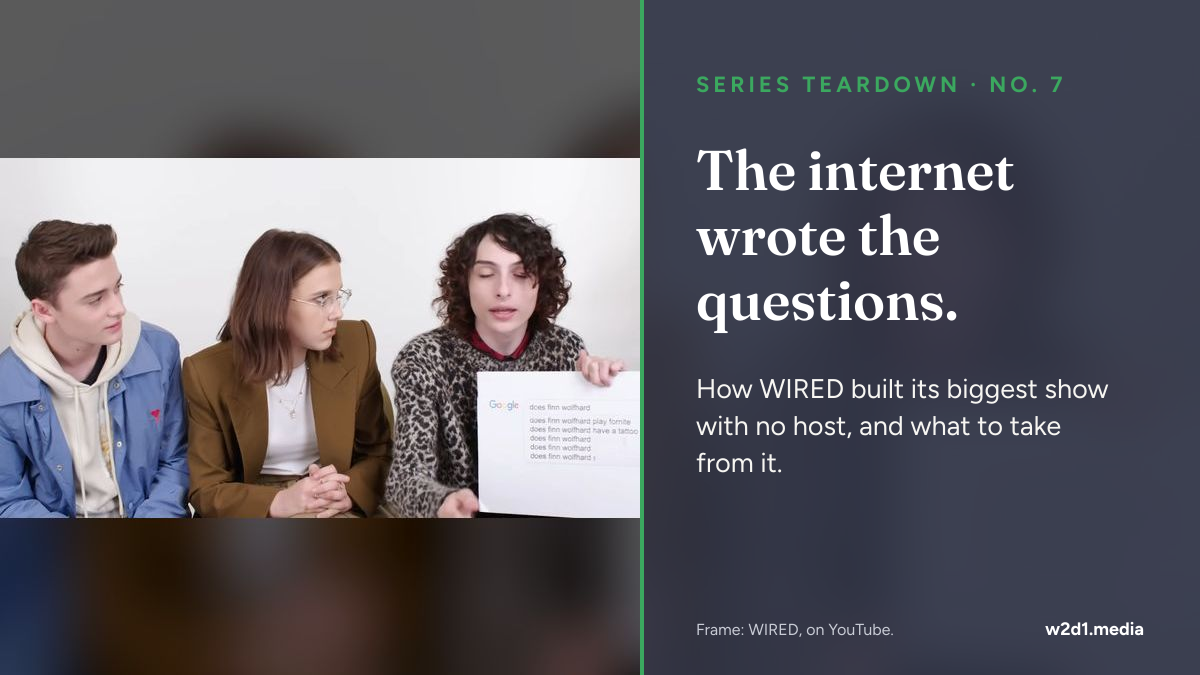
A celebrity stands in front of a board. On the board are the things Google suggests when people type their name: "does Anne Hathaway sing", "is Daniel Radcliffe married", "what does Gerard Butler eat". The questions are written in the third person, often ungrammatical, covered with strips of tape. The guest peels a strip, reads the question aloud, answers it, peels the next one. Nobody asks them anything. There is no interviewer in the room, or at least none you ever hear.
Episodes run about nine minutes, per the TV database listing. The first one, with Gerard Butler, went up on 1 March 2016 and ran three minutes. There have been well over 300 since. Watch a famous one: the Stranger Things cast on YouTube, from July 2019, which a third-party count puts near 70 million views.
How it started
The Autocomplete Interview was built inside Condé Nast Entertainment, the video arm the magazine group set up to turn its titles into YouTube franchises, and it carries the fingerprints of one person. Joe Sabia, then the division's senior vice president of creative development, is credited by Variety and the Boston Globe with developing it, alongside Vogue's 73 Questions, which he also made. The show launched on WIRED's channel in March 2016. By its tenth episode in June that year, per Tubefilter, it was still called the "Google Autocomplete Interview" and was being used on YouTubers like the Slow Mo Guys rather than film stars.
Sabia's stated philosophy, to the Television Academy in 2017, was that digital content needs "a compelling hook or something that people have never seen before." His boss at the time, Dawn Ostroff, told Marketplace the same year that the division's job was to "create franchises, as we call them, from scratch." That word, franchise, is the whole story. WIRED did not set out to make an interview show. It set out to make a repeatable object that any guest could be dropped into.
It grew the way franchises do. A 2017 doctoral thesis cited on Wikipedia put the first 30 videos at more than 80 million views. By January 2019 Ad Age called it WIRED's most popular video series, at 400 million views across platforms. By 2023 the figure being quoted, including by Sabia's own studio, was over a billion, and the studio calls it the most-viewed format in the Condé Nast portfolio. Treat those as the makers' numbers. Along the way it was syndicated to Facebook Watch in 2017 and Snapchat Discover in 2019, parodied by Saturday Night Live in 2023, copied by Boris Johnson's team for a Brexit video and by a German party leader in 2025, and in September 2024 the sitting Vice President of the United States taped one at her party's headquarters during an election campaign. A format has arrived when politicians use it to look human.
Why it works
Here is what I think is doing the work.
The internet writes the questions, so nobody has to. Every interview show has the same problem: the host has to ask something the guest has been asked a thousand times, and the guest has to pretend it is fresh. Autocomplete removes the host from the transaction. The questions are not WIRED's. They are, on their face, what the public typed. That gives the guest permission to answer dumb questions with good humour, because nobody in the room is being dumb, and it gives the viewer the feeling that their own curiosity is on the board. One caveat worth knowing: Wikipedia notes that autocomplete suggestions are not the most common searches, and nothing published says how the questions are chosen. Somebody picks them. The format just makes that invisible.
The peel is a reveal, every twenty seconds. The tape is not decoration. Every strip is a tiny moment of suspense: the guest does not know what is under it, and neither do you. A nine-minute video with 25 small reveals in it has a retention structure that most interviews never get. Hot Ones does the same thing with ten wings. Career Ladder does it with a timer. The mechanic is the editor.
It fits inside a junket. Wikipedia records that the interviews are usually shot during press junkets, and the White House pool report for the Harris episode shows how little it takes: a room, a board, a few minutes. A publicist can say yes to nine minutes with no interviewer and no gotcha. That is why the guest list reads like a film release calendar and why the show never runs out of subjects. Access, not creativity, is what most formats run out of first.
The format is the star, so the host cannot leave. WIRED does not have a Sean Evans. Nobody's career is attached to the show, which means nobody can take it with them, ask for a raise, or get cancelled. The same creator built 73 Questions for Vogue on the same principle: a rigid mechanic that any guest fills. Sabia's line in a 2020 interview was that "the concept itself is only 1% of the battle." The other 99 percent is the discipline of never changing it.
It costs almost nothing per episode. A board, tape, one camera set-up, a crew that a production credit list describes as a line producer, a couple of associate producers, a booker and camera. That is how you get to 366 episodes. The expensive part of a franchise is the first one.
What it costs to make
This is the instalment where the honest answer is that the costs are mostly hidden, and the hidden ones are the point.
The visible production is cheap. What is not cheap is the thing WIRED already had: a publicist's phone number for every film release in the calendar. The Autocomplete Interview works because studios route their stars through Condé Nast's offices on press tours, and it has done for a decade. Copy the board and the tape and you will have the mechanic. You will not have Millie Bobby Brown.
The second hidden cost is editorial. Somebody reads the autocomplete results, decides which 25 go on the board, and in what order, so that the episode builds. That curation is never shown, because showing it would break the illusion that the internet asked. It is real work, and it is where the show lives or dies.
The third cost is the platform. VideoWeek reported in May 2024 that Condé Nast's five big mid-length series, Autocomplete among them, pulled a combined 500 million views in a year, and that mid-length video was "not picking up as many views as they used to" because of Shorts. A nine-minute format built for 2016 YouTube is now competing with 30-second ones. The franchise is still enormous. It is no longer growing the way it did.
What to steal
Let your audience write the questions, and say so on screen. You do not need Google. You have an inbox, a comments section, a search box on your site, the questions prospects ask on sales calls. Put them on a board, literally or not, and let the guest answer the audience instead of you. The permission it gives both sides is the whole trick.
Build a reveal into every minute. Give the viewer something they do not know yet, at a fixed interval. A strip of tape, a sauce, a timer, a sealed envelope. The device matters less than the interval.
Design for the guest's calendar, not yours. Nine minutes, no prep, no interviewer to perform for. If your format can be done in the time a publicist gives a junket slot, your guest list stops being the constraint.
Make the format the star. If the show only works with you in the chair, you own a job. If it works with anyone in the chair, you own a franchise. Decide which you are building before episode one.
Copy the mechanic, not the access. WIRED's real advantage is the press tour, and you cannot borrow it. Find the equivalent you can own: the founders who already come to your events, the investors already on your show, the customers already in your CRM. Then build the board for them.