
One song. The person who made it takes it apart, layer by layer, in their own words. The host's questions are edited out so you never hear him. Twelve years, more than 300 episodes, a Netflix series and a residency at the Sydney Opera House. Here is why removing yourself can be the format, and what to take from it.
Series Teardown is a column about content series that are unusual in format and have the evidence to show they work. One series per instalment: how it started, the mechanics underneath it, the production reality nobody posts about, and what you can take from it for your own show. This one is a podcast, the first in the column, and its mechanic is the one most podcasters would find hardest to copy: the host is not in it.
The premise
Each episode of Song Exploder is one song. The musician who wrote it talks you through how it was made, and as they do, you hear the parts in isolation: the drum loop on its own, the first vocal take, the synth that was almost cut. At the end you hear the finished song, and it sounds different because you now know what is in it. Hrishikesh Hirway, who makes the show, interviews the artist for up to 90 minutes and then, per the show's own about page, edits his side of the conversation out entirely. Only the artist speaks. Episodes run 15 to 30 minutes.
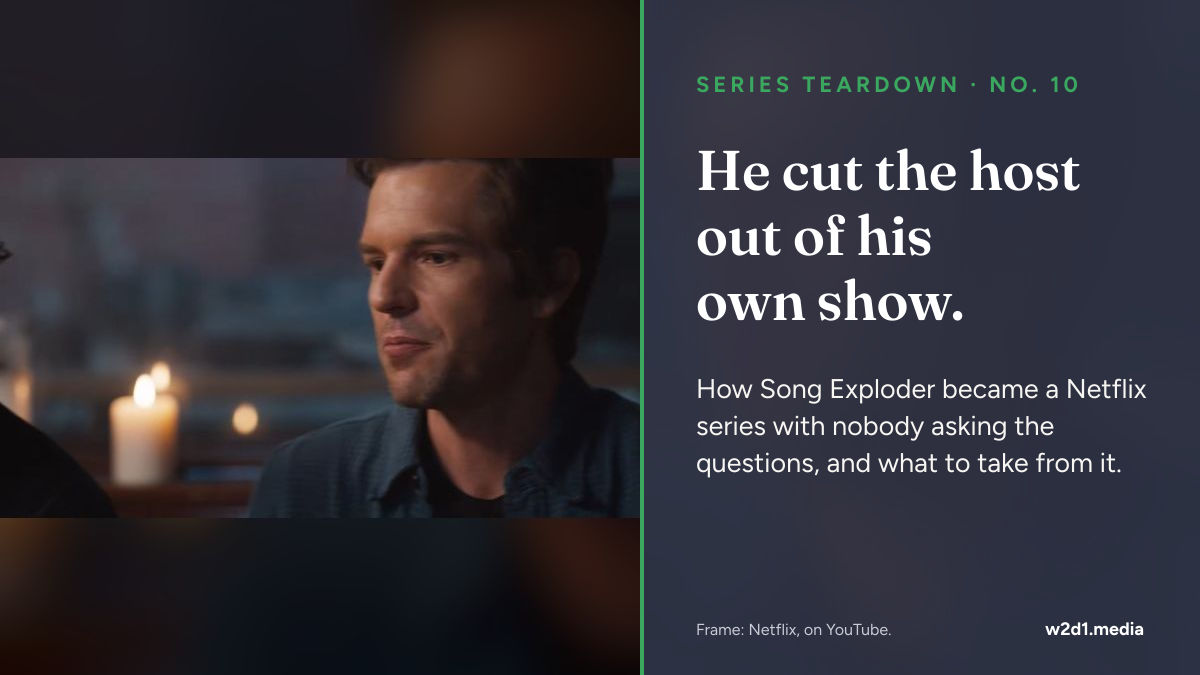
It launched on 1 January 2014 with The Postal Service and had passed 300 numbered episodes by 2025; Lady Gaga was number 300. Watch The Killers taking apart "When You Were Young" in the Netflix version, on YouTube.
How it started
Hirway is a musician first. Four albums as The One AM Radio over nine years, then film and television scores, per the Boston Globe. The first episode was recorded as a pilot called "Deconstructed", and he told the Daily Beast in 2024 that he had never interviewed anyone before. The show went out on Maximum Fun, then independently, then joined Radiotopia in June 2015, where it still sits.
The idea that defines it was not in the plan. KQED reported in 2015 that the talking parts "were not in the show's original concept" and were the part Hirway was least comfortable with. His answer was to cut himself out and build each episode from the artist's words alone. He has described the job, borrowing a phrase from Roman Mars, as "writing with other people's words," and told his old school's magazine in 2019 that he builds the story "layer by layer, so that people don't feel left out if they aren't already a fan of the artist." Mars, who runs Radiotopia, called it "a 99% Invisible for songs" in 2014. Hirway's own test, to Vice in 2015: "I think the show works best when it's surprising."
The evidence it works is the guest list and what happened next. Fleetwood Mac, Billie Eilish, U2, Metallica, Lorde, Yo-Yo Ma, Madonna, Paul McCartney, Lady Gaga, per the show's own page and its publicist. KQED reported close to 100,000 listens an episode in 2015; by 2020 Grammy.com had the total above 60 million streams and downloads, and the Boston Globe above 65 million in 2022, all self-reported. Trent Reznor asked Hirway whether he had ever thought about making it into television, per uDiscover, and in October 2020 Netflix released Song Exploder as a series, produced with the documentary maker Morgan Neville: Alicia Keys, Lin-Manuel Miranda, R.E.M., Dua Lipa, The Killers, Nine Inch Nails. There was a Sydney Opera House residency in 2016, a live orchestral version with the Toronto Symphony in 2024, a Webby in 2022, and a spin-off about books with Susan Orlean.
Why it works
Here is what I think is doing the work.
Removing the host removed the interview. An interview has two people performing for a third. Take out the interviewer and what is left is a person explaining their own work to you directly, with no small talk, no "great question", no host trying to be interesting. Hirway did not invent this because he was shy, though KQED suggests he was. He did it because the talking parts were the weak part of the show and the artist's words were the strong part. Most hosts would have fixed the weak part by getting better at it. He deleted it.
The structure is the song's structure. Every episode has the same shape because every song does: a first idea, the parts that were added, the parts that were cut, the finished thing. Hirway does not have to invent a story. He told the Boston Globe he wanted listeners to "taste the individual ingredients before they have the final dish," and the dish supplies the shape. The ending is guaranteed to pay off because you already know the song, and now you know it differently.
It is made from material nobody else has. The isolated tracks, the stems, come from the artist. "A lot of it comes down to getting lucky with what was preserved," he told Mix in 2020. That is a format built on an asset only the guest can provide, which means every episode is unrepeatable and no imitator can make the same one. Compare that with an interview, where the guest's answers are available to anyone with a microphone.
It flatters the right people. Artists get a document of their own craft, in their own voice, that will be the best explanation of that song ever made. That is why the guest list looks like it does and why labels tolerate the licensing cost. Hirway told Podnews in 2020 that many labels still charge him to license the music in each episode, which means every episode of a free podcast costs money to publish. He pays it because the format only works with the real thing.
It translated to television without changing. The Netflix version is the same shape: one song, the artist, the stems, the ending. Formats that are really about a host's personality rarely survive the move to another medium. Formats that are about a structure do. Hirway told Grammy.com in 2020 that television "can't be tied to your promotional calendar" the way a podcast can; the structure survived, the cadence did not.
What it costs to make
More than the finished episode suggests, and the cost is mostly time and tape.
Up to 90 minutes of interview, per Mix, cut to under 30 minutes of someone else's voice, in a Pro Tools session that layers the artist's words over their own stems. "Several rounds of revisions," finished "usually three weeks later." A team of three at that point: Hirway, a producer and an assistant. Twice a month for twelve years. The editing of a show with no host is harder than the editing of a show with one, because there is nothing to bridge the gaps except craft.
The second cost is the stems. The format depends on the artist handing over the raw multitracks of their song, and on those files existing at all. Hirway described it to Tape Op this year as "like I'm doing a remix with the stems of the song." If the files were not kept, there is no episode.
The third cost is money going out of a free show. Licensing fees to labels on every episode, which Hirway has said makes it impossible to promise the archive will stay online forever. A format built on other people's intellectual property has a permanent rent.
What to steal
If the host is the weak part, remove the host. Listen back to your own episodes and ask which half is carrying it. If it is the guest, consider a format in which you edit yourself out and let them speak to the listener directly. It is harder to make and better to hear.
Borrow a structure that already has an ending. A song, a deal, a launch, a hire: anything with a beginning, a middle and a known result gives every episode a shape you do not have to invent.
Build on material only the guest can provide. Stems, the original pitch deck, the first spreadsheet, the rejected logo. A format made from artefacts is unrepeatable, and nobody can copy an episode of it.
Make the guest's incentive the document. Give them the best record of their own work that will ever exist. The guest list follows.
Design the structure to outlive the medium. If your format is a shape rather than a personality, it can move to video, to a stage, to a book. Hirway's did, with the host still absent.