
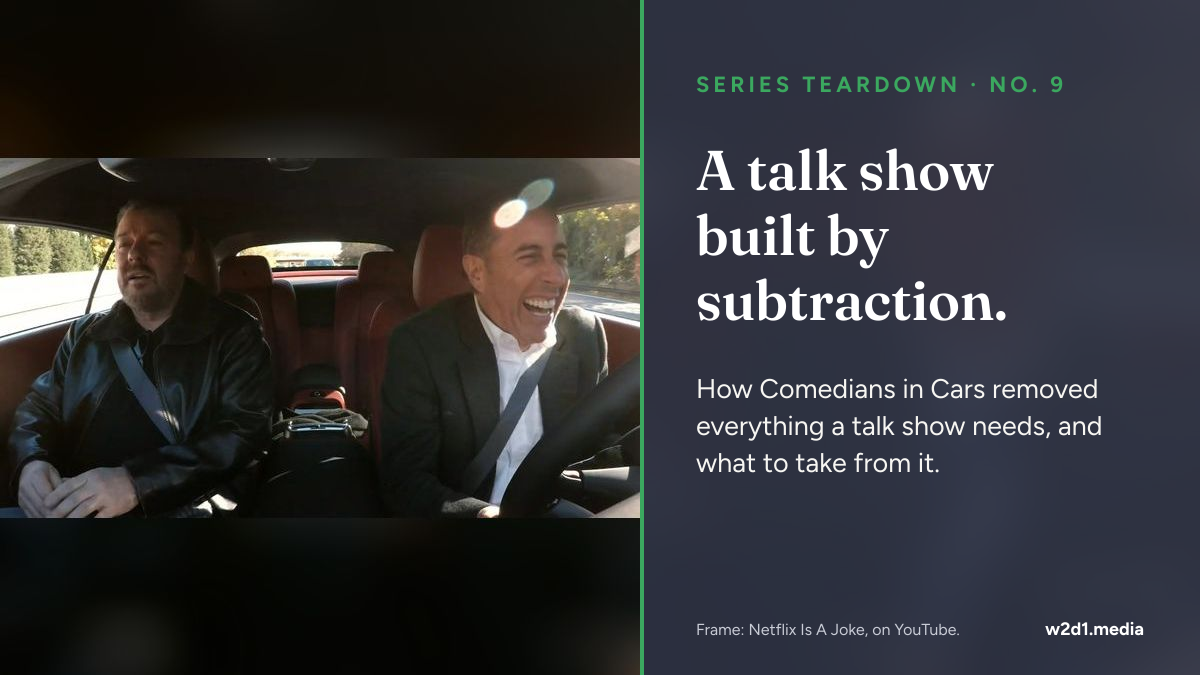
A vintage car, a drive, a coffee, and one comedian. No desk, no band, no audience, no clips to plug. Seinfeld made 84 episodes of it, sold the lot to Netflix in a deal reported at up to US$100 million, and then stopped because the editing wore him out. Here is why the format worked, what it actually cost, and what to take from it.
Series Teardown is a column about content series that are unusual in format and have the evidence to show they work. One series per instalment: how it started, the mechanics underneath it, the production reality nobody posts about, and what you can take from it for your own show. This one is the most explicit case I know of a format designed by subtraction.
The premise
Jerry Seinfeld picks a classic car he thinks suits his guest, drives to a cafe, and they have coffee. That is the episode. The car is explained, the drive is filmed, the coffee is drunk, and somewhere in 15 to 20 minutes two comedians talk about comedy the way they would if nobody were listening. There is no studio, no audience, no band and no desk. Wikipedia lists 84 episodes across 11 seasons, from July 2012 on Crackle to July 2019 on Netflix. Watch the best of the final season, on Netflix's YouTube channel.
How it started
The idea, Seinfeld told the Associated Press in January 2014, came from the Seinfeld episode in which George does the opposite of everything he would normally do. He wanted a talk show that was the opposite of the typical show: "you have to go to a studio," "you have to put on makeup," and "outside and moving is the opposite of inside and still." He told the Hollywood Reporter in 2013 that conventional talk shows "need the audience and the band for the energy, and people want to show their clips," and that this was "a personal experiment of mine." Earlier still, there was a drive he took in 2000 from New Mexico to the Hamptons in a 1967 Beetle he had bought on eBay, with a writer friend, which he has described as the seed.
It launched on Crackle, Sony's web video arm, on 19 July 2012. Seinfeld said at the time, per a Sony release the following June, that "not everyone understood what we were doing." Social media advisers told him web video over five minutes would not work, he recalled in a 2018 interview, and his answer was that his viewers were averaging 19 minutes. Acura signed on as sole sponsor in June 2013 for 24 episodes, with its cars integrated into the drives, and Sony claimed more than 10 million streams by then. Sony reps told Tubefilter in January 2014 the first 20 episodes had passed 25 million views; the New York Times put the total near 100 million by mid-2015. All of those are the platform's own numbers.
In January 2017 Netflix took the show: 24 new episodes, the 59-episode back catalogue, two stand-up specials and a development deal, after a bidding contest with Hulu, per the New York Times. The terms were not disclosed; the Hollywood Reporter, citing industry sources, estimated the package at up to US$100 million, and that figure has travelled ever since as if it were confirmed. It is not. The show earned five Emmy nominations between 2013 and 2020 and won none. In December 2015 Barack Obama did an episode in a 1963 Corvette that could not leave the White House grounds.
The eleventh season, in July 2019, was the last. Asked in May 2020, Seinfeld said he had not planned any more: "the editing is very intense... I feel like I may have done that exploration at this point." In late 2021 he said he was putting "that volume on the shelf."
Why it works
Here is what I think is doing the work, and most of it is what is missing.
It was designed by subtraction. Seinfeld did not add a gimmick to a talk show. He listed what talk shows need, the studio, the makeup, the audience, the band, the clips, and removed each one. What is left is two people in a confined space with nothing to perform to. He told a Paley Center audience in 2014 that removing the audience stops comedians slipping into their acts, and that "moving people around keeps them awake." Every one of those removals is a cost saving and a creative decision at the same time.
The car does the host's job. A talk show host has to make a guest feel special in the first minute. Seinfeld does it with the car: a specific, slightly absurd object chosen for this person and explained with love. "A car is a companion that is also a practical tool," he told Sprudge in 2018. The guest arrives already flattered and already amused, and the drive gives the conversation somewhere to go before anyone has said anything clever. It is the same job the ladder does in Career Ladder and the wings do in Hot Ones, done with more money.
It is the opposite of a promotional stop. No clips, no release to plug, no questions a publicist wrote. Seinfeld's line was that he "wanted to make a show that people would like to be on, instead of groaning." That is why comedians who never do press did this, and why David Letterman refused to be paid for his episode, per HuffPost. The format's value to the guest is that it asks nothing of them. That is a booking advantage no budget can buy.
The length was the bet. Everyone in 2012 said web video had to be short. Seinfeld made 15 to 20 minutes and claimed 19-minute average watch times. He was right about his audience and wrong about the medium in general, which is the point: a format should be the length its own audience wants, not the length the platform's averages suggest.
The edit is where the show is made. Roughly three and a half hours of footage per episode, cut to under 20 minutes over a few weeks with Seinfeld in the room, per HuffPost's account of the Paley event. "There has to be some reason for every shot," he told Sprudge. "We can't have any dead air." He called the result a "video lozenge." The show looks effortless because the effort went into the cut.
What it costs to make
More than it looks. HuffPost's 2014 report put the cost at roughly US$100,000 an episode, an estimate, for a show about two men drinking coffee. Classic cars have to be sourced, insured and sometimes trailered. A cafe has to be closed or wired. Three and a half hours of two-camera footage has to be cut by someone who will not release it until every shot has a reason. There were no writers and no directors, which sounds cheap until you realise it means the star did those jobs.
The second cost is the one that ended it. Seinfeld's stated reason for stopping was not the audience or the money. It was that the editing was intense and he felt he had finished the exploration. A format that depends on its star's personal taste in the edit is a format that stops when the star is tired. Eighty-four episodes is a long run for a one-man show. It is a short one for a franchise.
The third cost is honesty about what made it work. I picked this instalment, and I will say the quiet part out loud: much of my love for this show is love for Jerry Seinfeld. The format is excellent. It is also carried by one of the most famous comedians alive, who could get any guest and any car. Subtract him and you have a pleasant idea. That is worth knowing before you copy it.
What to steal
Design by subtraction. Write down everything a show in your category needs. Remove each one and ask whether the show still works. What survives is your format, and it is cheaper.
Give the guest a reason to want to be on. No plug, no clips, no publicist's questions. If appearing on your show costs the guest nothing and gives them a good afternoon, your booking problem shrinks.
Pick the object that does the host's job. The car flatters the guest before a word is spoken. Find the equivalent: the venue, the prop, the ritual that makes a guest feel chosen.
Set the length by your audience, not the platform. Seinfeld's 19 minutes against everyone's five. If your people watch, the average is wrong.
Know what the star is carrying. Be honest about how much of your format's appeal is the person in it. If it is most of it, you are building a show, not a franchise, and you should plan for the day the person is tired.