
Two potted ferns, a public-access set, and a host who is rude to famous people on purpose. Zach Galifianakis made about two episodes a year. One of them sent tens of thousands of people to healthcare.gov in a day and won an Emmy. Here is why a format this thin held up for a decade, and what to take from it.
Series Teardown is a column about content series that are unusual in format and have the evidence to show they work. One series per instalment: how it started, the mechanics underneath it, the production reality nobody posts about, and what you can take from it for your own show. This one is the rare format whose effect was measured by the White House.
The premise
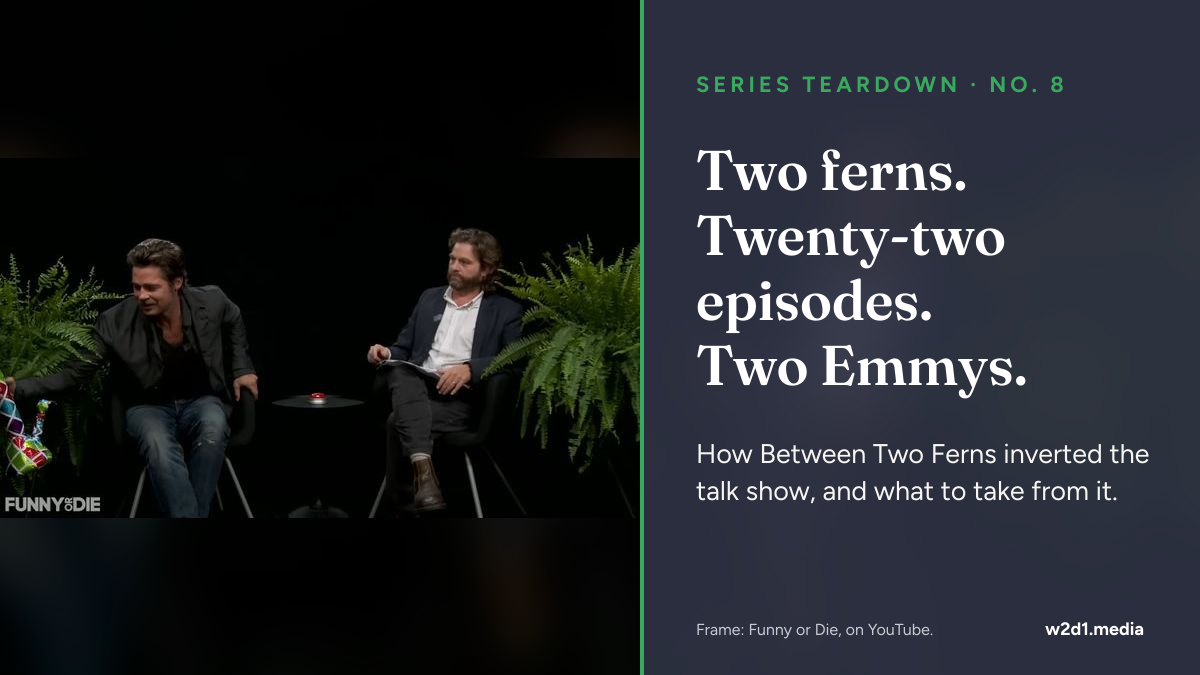
Zach Galifianakis sits at a desk between two potted ferns on a set that looks like a cable-access show from 1988. The graphics are wrong on purpose. The guest is famous. He is awkward, bored and hostile, asks questions nobody should ask, and the guest has to decide in real time how to play it. Three to six minutes. A deodorant plug is usually worked in somewhere.
Wikipedia records 21 episodes and one television special between January 2008 and June 2018. Call it two a year. Watch the Brad Pitt one from October 2014, on Funny or Die's YouTube channel: Pitt gets called "Bradley Pitts", Louis C.K. wanders in, and the gum Pitt spits at the host was, Galifianakis said in 2026, arranged beforehand. The counter on that video was near 39 million views when I checked.
How it started
The first episode, with Michael Cera, went up on 4 January 2008. It began, per Wikipedia, as a sketch inside a Fox pilot by Scott Aukerman and B.J. Porter that Fox passed on; the pair put it on Funny or Die instead, and the three of them have made it together since. Galifianakis told ABC News in 2010 that the show started as a way to mock "the sycophantic way that Hollywood machine runs." The Chicago Tribune called it, in 2012, a critique of the faked intimacy of celebrity interviews. That is exactly what it is. Every other talk show pretends the host and guest are friends. This one pretends they are enemies, which is closer to the truth and much funnier.
Then, on 11 March 2014, the President of the United States sat between the ferns to promote healthcare.gov before an enrolment deadline. Funny or Die reported a million views in under twelve hours. By the next afternoon CNN had it at 6.5 million. The White House's own figures, reported by The Hill that day, were 11 million views, traffic to healthcare.gov up almost 40 percent on the day before, and 32,000 direct referrals by six in the evening, a figure the administration later put at 54,000. The press secretary said Funny or Die was the site's number one referrer that day. Nobody published how many of those visitors enrolled, and critics pointed out at the time that a referral is not a sign-up. Even so: a six-minute comedy video was, for one day, the biggest driver of traffic to a government service, and the Television Academy gave it the Emmy for short-format live-action entertainment that September. The Brad Pitt episode won the same award the following year.
In September 2016 Hillary Clinton did one, mid-campaign. Funny or Die told the Hollywood Reporter it had the best first day in the site's history, more than 30 million views in 24 hours, and matched the Obama episode's total within four days. In 2019 Netflix released a feature film built on the format. No audience figure for the film was ever published.
Why it works
Here is what I think is doing the work.
It inverts the one thing every interview show does. Talk shows run on flattery. The guest is wonderful, the film is wonderful, everyone is thrilled to be here. Between Two Ferns runs on the opposite assumption and lets the guest react. The comedy is not in the questions. It is in watching a very famous person decide whether to be a good sport. That is a reaction the guest cannot prepare, which is why Galifianakis withheld the questions from everyone but Obama, as he said on Vulture's podcast in April 2026. He has also said he was never interested in pranking anyone and offered to cut anything a guest found offensive. The hostility is a costume. The trust underneath it is real, and the guests knew it.
The set is the joke, and the set costs nothing. Two ferns, a desk, bad graphics. The cheapness is not a limitation the show overcame. It is the premise. A public-access aesthetic tells the viewer in one frame that nothing here is to be taken seriously, which frees the guest and frees the host. Aukerman told the Los Angeles Times in 2019 that the format had to be "low-concept enough" to set up on the fly and make quickly. When the White House offered 50 minutes and then cut it to 15 two minutes into the first take, per Ken Jennings's account in Planet Funny, the show could absorb it because there was nothing to set up.
Scarcity did the marketing. Two episodes a year for a decade. Each one was an event because there was never a schedule to get used to. The Clinton episode was the first in almost two years, which is part of why it did 30 million views in a day. Most series try to win on consistency. This one won on the opposite: every episode was a surprise because nobody expected one.
The edit is the writer. Guests sat for an hour or two with no publicist in the room, per Jennings, and the comedy was mostly built in the cut. Funny or Die's Mike Farah told CNN the Obama shoot took barely longer than the finished six and a half minutes, but that was the exception. The usual method was to let a famous person be uncomfortable for a long time and keep the three minutes where it worked.
It had one job it could prove. The Obama episode existed to send people to a website before a deadline, and the White House counted. Most branded content cannot say what it was for. This one could, and that is why the numbers were published at all.
What it costs to make
The production cost is close to nothing and no source puts a figure on it. The real costs are elsewhere.
The first is the host. This format is not transferable. It works because Galifianakis is willing to be disliked for six minutes and has the standing to get Brad Pitt into the chair. Twenty-two episodes in ten years is partly scarcity by design and partly the fact that there was one person who could do it, and he had a film career to run.
The second is the guest's goodwill, which the format spends every time. Galifianakis ended the Sean Penn taping early because, he said this year, he thought someone was going to hit him. The withheld questions, the one-take shoots, the edit that keeps the worst moment: all of it depends on the guest agreeing afterwards that it was worth it. Most did. The show never had to find out what happened when one did not, in public.
The third is the one Galifianakis named himself in April 2026, when asked why the show stopped: "We're living in meaner times, and I don't know if it works anymore." A format built on pretend hostility needs an audience that can tell the difference. He is not sure it still can.
What to steal
Invert the genre's politeness. Find the one convention every show in your category obeys, the flattery, the warm-up, the plug, and build a format that does the opposite. The inversion is the hook, and it costs nothing.
Make the cheapness the premise. If your budget is small, do not hide it. Put it in frame, as the ferns do, and let it tell the viewer what kind of show this is. A format that depends on a big set cannot be shot in a White House side room in fifteen minutes.
Do fewer, and make each one an event. Two a year worked because each one was a surprise. If you cannot sustain weekly, do not pretend to. Pick a cadence you can make feel rare.
Withhold the questions. The best moment in every episode is the guest deciding how to react. Give them the questions in advance and you lose it. Give them trust instead: the promise to cut anything they hate, kept every time.
Give one episode a job you can count. The Obama episode had a deadline and a website. That is why we know it worked. Make at least one instalment of your series responsible for a number, and publish it.