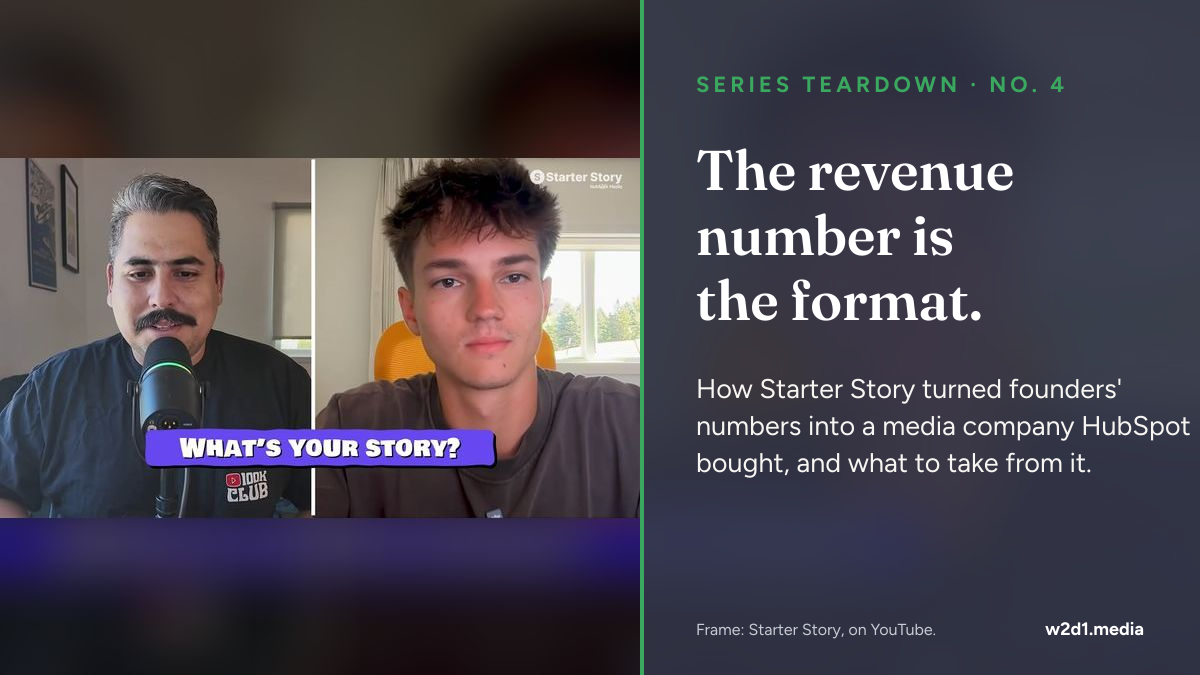
A founder, their monthly revenue, and how they got there. Pat Walls ran that one format for eight years, first as written case studies and then on YouTube, until HubSpot bought the company in February 2026. Here is what the format did, what it cost, and what to take from it.
Series Teardown is a column about content series that are unusual in format and have the evidence to show they work. One series per instalment: how it started, the mechanics underneath it, the production reality nobody posts about, and what you can take from it for your own show. The first three were Career Ladder, Subway Takes and Hot Ones. This one is the first that is not an interview gimmick, and the first with an exit at the end of it.
The premise
Starter Story tells you how much money a small business makes, and then how it got there. That is the whole format. On the website it is a case study: a founder answers a long questionnaire about the idea, how they built it, how they got customers and what the numbers are. On YouTube it is a short documentary with the revenue in the title. HubSpot's announcement of the acquisition put the library at more than 4,500 founder case studies and interviews.
The revenue number is not a detail. It is the hook, the filter and the promise. For a typical episode, watch My First SaaS Project Just Hit $11K/Month on YouTube.
How it started
Pat Walls was a software engineer with a failed startup behind him. He and some friends had built a B2B tool for small brands in 2016, missed out on Y Combinator and shut it down. He wanted something he could run alone, so in October 2017 he started interviewing founders he knew and publishing the answers. Simon Owens's 2022 profile has the detail: interviews by phone were too slow, so Walls emailed founders a questionnaire with sub-questions telling non-writers how long each answer should be. He coded his own CMS rather than use WordPress. He posted on nights and weekends with no business model.
The first year, per that profile, brought 439,856 page views and about US$1,700 a month. Klaviyo signed on as exclusive sponsor in March 2019 at US$4,000 a month, per Growth in Reverse. Reddit did the early distribution: Walls put whole interviews into posts with a single link back, and about one in ten visitors who came that way joined the newsletter. He made his first hire in 2020, when the business was making US$5,000 a month, and sold a search-engine optimisation course that took US$28,226 in its first week that December.
By 2022 the site had about 1.4 million monthly visitors and more than US$500,000 in annual revenue, per Owens. By 2023, per Growth in Reverse, 1.6 million visitors and more than US$1 million, with about 57 percent of revenue from sponsorship and ads and 38 percent from subscriptions and courses. Then video. Walls's own year-end post for 2024 claimed 115 million views on the content and 317,000 new YouTube subscribers in the year. On 23 February 2026 HubSpot's media division announced it had acquired the company. Adweek put the channel at more than 800,000 subscribers, the newsletter at about 275,000, the total audience at about 1.6 million, the revenue at "seven figures" on Walls's description, and the staff at three: Walls, his sister Sam as chief operating officer, and producer Gus Tiffer. The price was not disclosed. Walls called it life-changing.
Why it works
Here is what I think is doing the work.
The number is the format. Most business content promises a lesson. Starter Story promises a figure, and the figure does three jobs at once. It is the hook, because a specific dollar amount in a title is impossible to scroll past. It is the filter, because a founder willing to publish their revenue is a founder with something real to say. And it is the promise, because the viewer knows before they click that the answer will be concrete. Walls described the site to Owens as "a mini Forbes for bootstrap businesses." Forbes publishes a list. He published the working.
The guest does the first draft. The written case studies scaled because founders wrote them. The questionnaire did the interviewing, the sub-questions did the editing, and an intake form let founders apply to be featured, so Walls stopped hunting for subjects. Owens quotes him on the hard part: "One of the biggest challenges is getting people to write well." His team marked up drafts asking for the specifics behind every claim. Thousands of case studies later, the archive was a searchable database that search engines loved, which is where most of the 1.6 million monthly visitors came from.
Packaging before production. When the format moved to video, the discipline moved with it. On My First Million, in the days before the deal closed, Walls walked through the system, as written up by Outlier Kit: every video starts with a prep document modelled on a film treatment, the title and thumbnail are locked before anything is filmed, each video is built around one idea rather than a founder's whole story, and the research starts with content the founder has already made that resonated, a Reddit post or a talk. Freelancers edit, a part-time producer runs the board, output is two or three videos a week. He calls locking the title first "selling the script before writing it." It is the opposite of recording an hour and hoping.
The audience became the product. In 2023 most of the money was sponsorship. By the sale, according to a widely shared summary of the deal, about three quarters of revenue came from Starter Story's own products: memberships that one report put at more than 10,000 paying members, courses, and a five-week "Build" sprint. The audience that arrived for the numbers stayed for the help, and paid for it. That is also why HubSpot bought it. Its own post on the deal says the strategy is to own audiences rather than rent attention through paid channels, and calls Starter Story's readers a "mindset fit": early-stage founders in the act of choosing tools.
Small on purpose. Three full-time people, at the point of sale, running a company with seven-figure revenue and a 1.6 million audience. The scale came from the format (the guest does the work), the system (freelancers against a documented process) and the archive (eight years of case studies compounding in search). Walls told My First Million that Starter Story took about a fifth of his energy and produced about four fifths of his revenue.
What it costs to make
Eight years is the first cost. The 2017 side project was a side project for a long time; revenue sat around US$8,000 a month for nearly a year before he went all in, per the Outlier Kit write-up, and it doubled the month he did.
The second cost is the unglamorous plumbing. A custom CMS. A questionnaire refined over thousands of founders. A newsletter list that was cut from 245,000 to about 80,000 in a 2022 clean-up before it was rebuilt, per Growth in Reverse. A Reddit posting system engineered to avoid spam filters. A production board in Notion that took two or three months to build before it could be handed off. None of this shows up in a two-minute clip with a revenue number in the title.
The third cost is platform risk, and it is real. Walls posted in 2025 that YouTube was threatening to remove the channel, and chose to call it a silver lining. Whatever the outcome, a media business whose biggest growth engine is a channel it does not own has a dependency it cannot manage. The newsletter, the archive and the paid products are the hedge, and they are also what made the company worth buying.
What to steal
Put the number in the title. Not "how a founder built a business" but what it makes, in dollars, up front. If your guests will not share a number, find a different specific: customers, churn, the price they charge. The specific is the hook and the filter at once.
Make the guest do the first draft. A good questionnaire with sub-questions beats an hour of unstructured interview for a case-study format. You get specifics, the guest gets a document they are proud of, and the format scales past your own hours.
Lock the packaging first. Decide the title, the thumbnail and the one idea before you record. If you cannot write the title, you do not have an episode yet.
Sell your own thing before you sell ads. Starter Story went from mostly sponsorship to mostly its own products, and that is the version an acquirer paid for. Ask what your audience would pay you for directly, then build that before the next sponsor deck.
Build for the buyer who needs your audience. HubSpot did not buy a YouTube channel. It bought a specific group of people at the moment they choose tools. If you know which company needs your audience, you know what to build and what to measure.